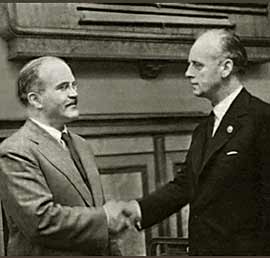
The Molotov–Ribbentrop Pact
Germany


4 min read
Updated By: History Editorial Network (HEN)
Published:
Updated:
The Molotov–Ribbentrop Pact, officially known as the Treaty of Non-Aggression between Germany and the Soviet Union, was a pivotal agreement that shaped the geopolitical landscape of Europe prior to World War II. Soviet Foreign Minister Vyacheslav Molotov's reaffirmation of this pact in the Supreme Soviet underscored the Soviet Union's commitment to its alliance with Nazi Germany. This agreement, signed in the late 1930s, included secret protocols that divided Eastern Europe into spheres of influence, allowing the Soviet Union to expand its territory significantly. Molotov's statements during this reaffirmation included strong criticisms of Britain and the United States, reflecting the tense international relations of the time and the Soviet Union's strategic positioning against Western powers. He also claimed that the boundaries of the Soviet Union had been extended to the shores of the Baltic Sea, indicating a shift in territorial control that would have lasting implications for the region and its inhabitants.
The reaffirmation of the Molotov–Ribbentrop Pact had profound consequences for the course of the war and the post-war order in Europe. It facilitated the Soviet Union's occupation of the Baltic states and parts of Poland, which were previously under the influence of other nations. This expansion not only altered the map of Europe but also set the stage for future conflicts as the balance of power shifted. The pact allowed Germany to focus its military efforts on Western Europe without fearing a Soviet intervention, leading to the rapid fall of France and the subsequent escalation of the war. The implications of this agreement were felt long after the war, as it contributed to the division of Europe during the Cold War, with the Soviet Union emerging as a superpower in Eastern Europe. The reaffirmation by Molotov served as a reminder of the complex alliances and enmities that characterized this tumultuous period in history.
#mooflife
#MomentOfLife
#Molotov-ribbentropPact
#SovietUnion
#WorldWarIi
#GeopoliticalHistory
#EasternEurope
Primary Reference
Molotov–Ribbentrop Pact

Explore the Life Moments of
 AI Twin