Tehran Conference
Germany
'%3e%3cg id='e'%3e%3cg id='c' fill='none' stroke='%23fff' stroke-width='2'%3e%3cpath id='b' d='M0 1h26M1 10V5h8v4h8V5h-5M4 9h2m20 0h-5V5h8m0-5v9h8V0m-4 0v9' transform='scale(1.4)'/%3e%3cpath id='a' d='M0 7h9m1 0h9' transform='scale(2.8)'/%3e%3cuse xlink:href='%23a' y='120'/%3e%3cuse xlink:href='%23b' y='145.2'/%3e%3c/g%3e%3cg id='d'%3e%3cuse xlink:href='%23c' x='56'/%3e%3cuse xlink:href='%23c' x='112'/%3e%3cuse xlink:href='%23c' x='168'/%3e%3c/g%3e%3c/g%3e%3cuse xlink:href='%23d' x='168'/%3e%3cuse xlink:href='%23e' x='392'/%3e%3c/g%3e%3cg fill='%23da0000' transform='matrix(45 0 0 45 315 180)'%3e%3cg id='f'%3e%3cpath d='M-.548.836A.912.912 0 0 0 .329-.722 1 1 0 0 1-.548.836'/%3e%3cpath d='M.618.661A.764.764 0 0 0 .422-.74 1 1 0 0 1 .618.661M0 1l-.05-1L0-.787a.31.31 0 0 0 .118.099V-.1l-.04.993zM-.02-.85 0-.831a.144.144 0 0 0 .252-.137A.136.136 0 0 1 0-.925'/%3e%3c/g%3e%3cuse xlink:href='%23f' transform='scale(-1 1)'/%3e%3c/g%3e%3c/svg%3e)

'%3e%3cpath fill='%23012169' d='M0 0v30h60V0z'/%3e%3cpath stroke='%23fff' stroke-width='6' d='m0 0 60 30m0-30L0 30'/%3e%3cpath stroke='%23C8102E' stroke-width='4' d='m0 0 60 30m0-30L0 30' clip-path='url(%23b)'/%3e%3cpath stroke='%23fff' stroke-width='10' d='M30 0v30M0 15h60'/%3e%3cpath stroke='%23C8102E' stroke-width='6' d='M30 0v30M0 15h60'/%3e%3c/g%3e%3c/svg%3e)

4 min read
Updated By: History Editorial Network (HEN)
Published:
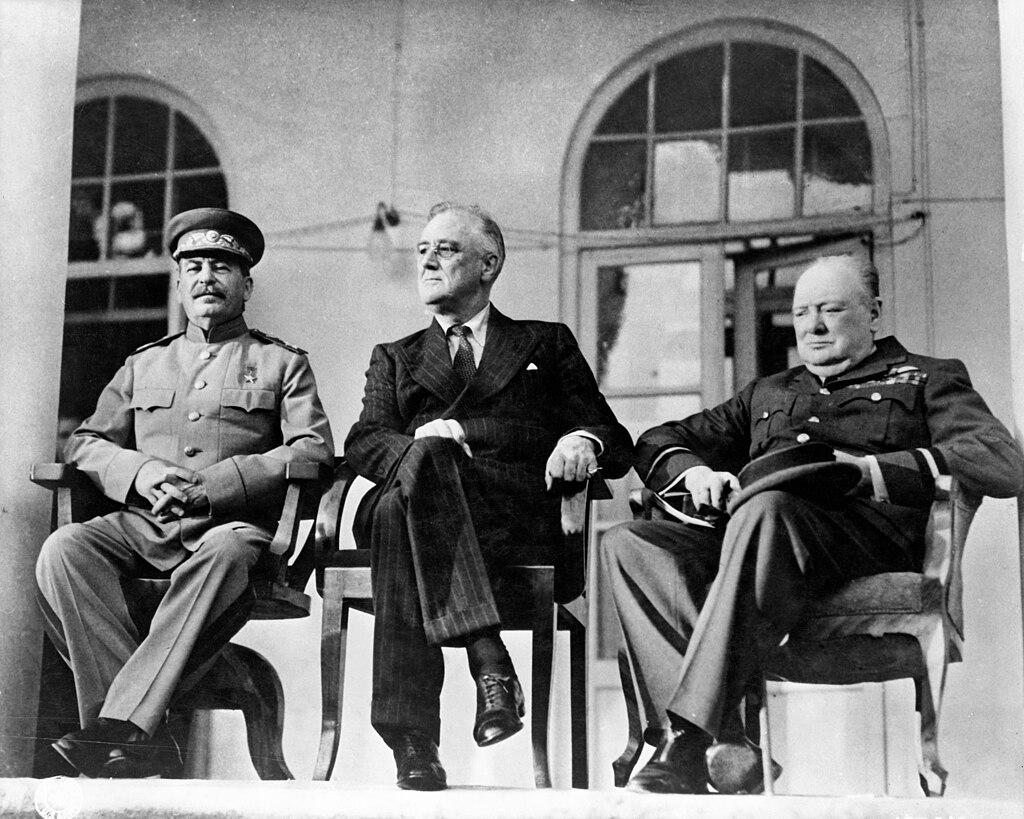
The Tehran Conference, held from 28 November to 1 December 1943, was the first meeting of the “Big Three” Allied leaders: Joseph Stalin of the Soviet Union, Franklin D. Roosevelt of the United States, and Winston Churchill of the United Kingdom. Convened in the Iranian capital, the conference addressed critical military and political issues as the Allies sought to coordinate their strategy for defeating Nazi Germany and shaping the postwar world.
A major outcome was the agreement to open a second front in Western Europe. Stalin had long pressed for this, and Roosevelt and Churchill confirmed plans for Operation Overlord, the cross-Channel invasion of France, scheduled for May 1944. In return, Stalin pledged that the Soviet Union would enter the war against Japan once Germany was defeated. The leaders also discussed operations in the Mediterranean, with differences over strategy, as Churchill favored further advances in the Balkans while Roosevelt and Stalin prioritized France.
Beyond military planning, the conference addressed postwar arrangements. The Allies agreed on the need to disarm and divide Germany, prevent its resurgence as a military power, and establish mechanisms for international security. Early outlines for what would become the United Nations were discussed, emphasizing collective security to maintain peace after the war.
The Tehran Conference represented a turning point in Allied cooperation, strengthening unity among the major powers. It laid the groundwork for decisive operations in 1944 and established a framework for postwar diplomacy, despite underlying tensions that would later emerge during the Cold War.
#MomentsOfLife #MoofLife_Moment #MoofLife #WWII #TehranConference #BigThree #AlliedStrategy #UnitedNationsBeginnings
Primary Reference
Tehran Conference

Explore the Life Moments of
 AI Twin