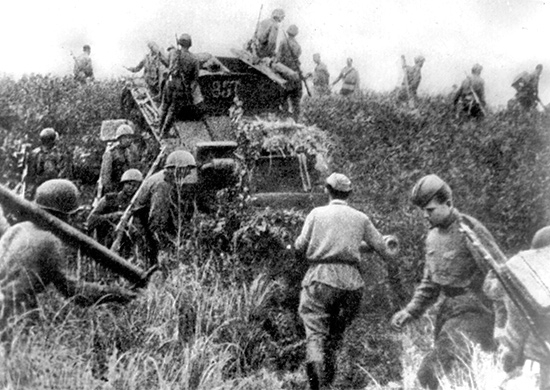
Soviet Union declares war on Japan, invades Manchuria
Germany

'%3e%3cpath fill='%23c4272f' d='M0 0h960v480H0z'/%3e%3cpath fill='%23015197' d='M320 0h320v480H320z'/%3e%3ccircle cx='160' cy='164' r='44'/%3e%3ccircle cx='160' cy='144' r='48' fill='%23c4272f'/%3e%3ccircle cx='160' cy='152' r='32'/%3e%3cpath d='M140 92a20 20 0 0 0 40 0c0-8-5-9-5-12s3-7-3-12c3 5-2 6-2 11s2 5 2 9a4 4 0 0 1-8 0c0-4 4-8 4-14s-1-8-4-13-8-9-4-13c-6 2-3 10-3 15s-4 8-4 14 3 7 3 11a4 4 0 0 1-8 0c0-4 2-4 2-9s-5-6-2-11c-6 5-3 9-3 12s-5 4-5 12ZM72 216v192h40V216Zm136 0v192h40V216Zm-88 32v16h80v-16Zm0 112v16h80v-16Zm0-144h80l-40 24Zm0 168h80l-40 24Z'/%3e%3c/g%3e%3cg stroke='%23c4272f' stroke-width='24'%3e%3ccircle cx='800' cy='1560' r='212'/%3e%3cpath fill='none' d='M800 1348a106 106 0 0 1 0 212 106 106 0 0 0 0 212'/%3e%3c/g%3e%3c/g%3e%3cg fill='%23c4272f'%3e%3ccircle cx='800' cy='1454' r='40'/%3e%3ccircle cx='800' cy='1666' r='40'/%3e%3c/g%3e%3c/svg%3e)

4 min read
Updated By: History Editorial Network (HEN)
Published:
On 8 August 1945, the Soviet Union declared war on Japan, fulfilling a commitment made at the Yalta Conference earlier that year. Shortly after midnight on 9 August, Soviet forces launched a massive offensive into Manchuria, a region under Japanese control since 1931. The operation, known as the Manchurian Strategic Offensive, was conducted by three powerful Soviet army groups—the Transbaikal Front, the 1st Far Eastern Front, and the 2nd Far Eastern Front—commanded by Marshal Aleksandr Vasilevsky. In total, more than 1.5 million Soviet troops, supported by thousands of tanks, aircraft, and artillery pieces, attacked the Japanese Kwantung Army, which was poorly equipped and significantly weakened by years of attrition.
The Soviet offensive was characterized by speed and overwhelming force, utilizing deep-penetration tactics developed during the war against Germany. The Japanese Kwantung Army, once regarded as among Japan’s elite forces, was unable to resist effectively. Within days, large numbers of Japanese soldiers were killed or captured, and Soviet forces advanced deep into Manchuria, reaching Mukden, Changchun, and Harbin. Simultaneous Soviet operations extended into Korea, Sakhalin, and the Kuril Islands.
The invasion of Manchuria had decisive consequences. It destroyed Japan’s last significant military presence on the Asian mainland and eliminated any hope of negotiating a mediated peace through Soviet channels. Combined with the atomic bombings of Hiroshima and Nagasaki, the Soviet entry into the war was a crucial factor compelling Japan to surrender on 15 August 1945, formally ending the Second World War.
#MomentsOfLife #MoofLife_Moment #MoofLife #WWII #SovietUnion #Japan #Manchuria #EndOfWar
Primary Reference
Soviet invasion of Manchuria

Explore the Life Moments of
 AI Twin