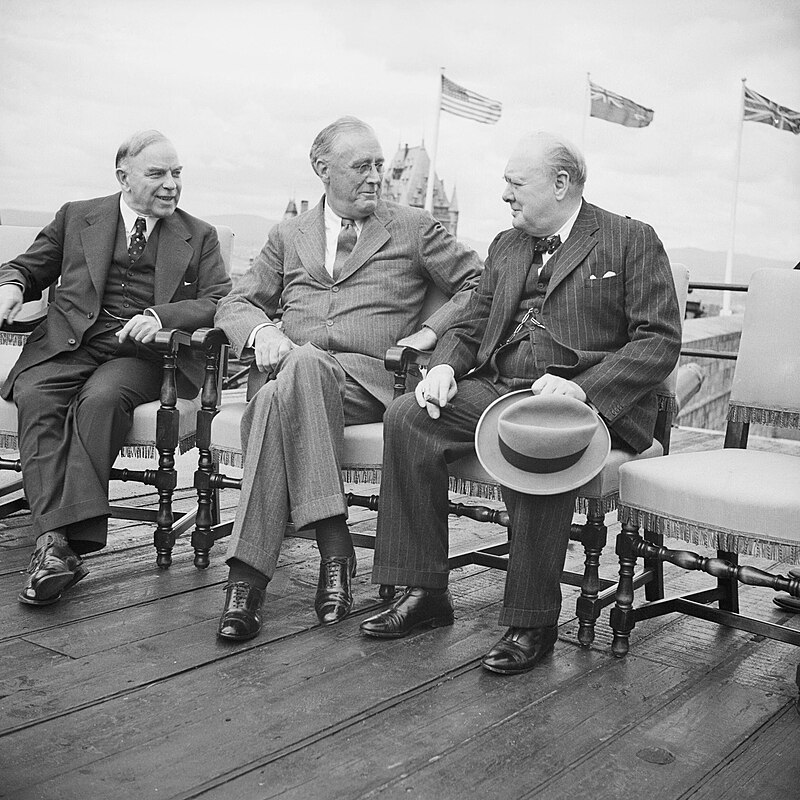
Quebec Agreement Signed by Roosevelt and Churchill
Germany
'%3e%3cpath fill='%23012169' d='M0 0v30h60V0z'/%3e%3cpath stroke='%23fff' stroke-width='6' d='m0 0 60 30m0-30L0 30'/%3e%3cpath stroke='%23C8102E' stroke-width='4' d='m0 0 60 30m0-30L0 30' clip-path='url(%23b)'/%3e%3cpath stroke='%23fff' stroke-width='10' d='M30 0v30M0 15h60'/%3e%3cpath stroke='%23C8102E' stroke-width='6' d='M30 0v30M0 15h60'/%3e%3c/g%3e%3c/svg%3e)

Politics
World War II
4 min read
Updated By: History Editorial Network (HEN)
Published:
Updated:
The Quebec Agreement was a pivotal accord signed by President Franklin D. Roosevelt of the United States and Prime Minister Winston Churchill of the United Kingdom during the Quebec Conference. This agreement primarily focused on the collaboration between the two nations in the development and use of atomic weapons. It marked a significant step in the Allied efforts during World War II, as both leaders recognized the potential of nuclear technology in warfare and the necessity of a coordinated approach to its development. The agreement established a framework for sharing information and resources related to atomic research, which was crucial for the Allied powers in their pursuit of military superiority over the Axis powers. The discussions at the conference also included strategies for the ongoing war efforts in Europe and the Pacific, highlighting the importance of unity among the Allies in achieving victory.
The impact of the Quebec Agreement extended beyond military strategy; it laid the groundwork for post-war nuclear policy and international relations. By committing to joint efforts in atomic research, the United States and the United Kingdom set a precedent for future collaborations in scientific and military endeavors. The agreement also foreshadowed the complexities of nuclear diplomacy that would emerge in the subsequent decades, as the implications of atomic power became a central issue in global politics. The Quebec Agreement is often viewed as a critical moment in the history of nuclear weapons development, influencing not only the course of World War II but also shaping the geopolitical landscape of the post-war era. The collaboration initiated by this agreement ultimately contributed to the establishment of nuclear arsenals and the arms race that characterized the Cold War.
#mooflife
#MomentOfLife
#QuebecAgreement
#RooseveltChurchill
#WorldWarIi
#AtomicWeapons
#AlliedPowers
Primary Reference
Quebec Agreement

Explore the Life Moments of
 AI Twin