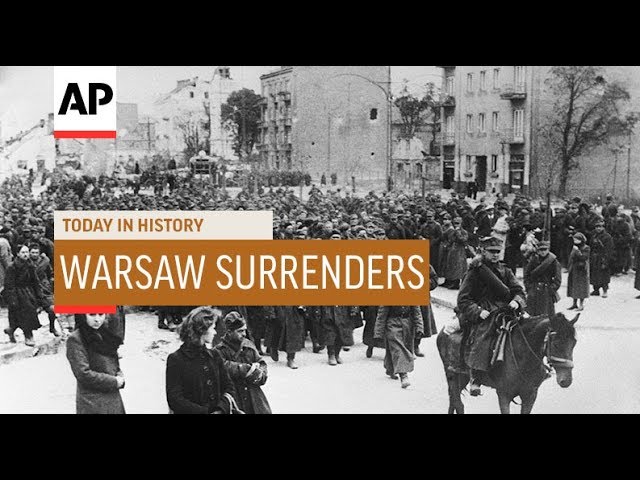
Polish Army Capitulates in Warsaw
Germany
Military
World War II
4 min read
Updated By: History Editorial Network (HEN)
Published:
Updated:
The capitulation of the Polish Army in Warsaw marked a critical point in the early stages of World War II. Following the invasion of Poland by German forces, which began with a coordinated attack that included air raids and ground assaults, the Polish military faced overwhelming odds. The German strategy involved rapid advances and the use of Blitzkrieg tactics, which combined air power with fast-moving ground troops. As the conflict escalated, the Polish forces were unable to sustain their defense against the superior military technology and tactics employed by the Germans. The situation in Warsaw deteriorated as supplies dwindled and morale weakened among the defenders. The remaining Polish army and militia, recognizing the futility of continued resistance, ultimately capitulated to the German forces in the center of the city. This surrender not only signified the fall of Warsaw but also the effective end of organized Polish military resistance in the face of the invasion.
The impact of this capitulation was profound, leading to the occupation of Poland by German and Soviet forces, as outlined in the Molotov-Ribbentrop Pact, which had previously divided Eastern Europe into spheres of influence. The fall of Warsaw was a significant blow to Polish sovereignty and marked the beginning of a harsh occupation that would last for several years. The Polish population faced severe repression, and the country was subjected to extensive military control. The capitulation also had broader implications for the Allied powers, as it highlighted the need for a coordinated response to the Axis powers' aggression. The events in Warsaw served as a catalyst for future military strategies and alliances, ultimately shaping the course of the war in Europe.
#mooflife
#MomentOfLife
#PolishArmy
#Warsaw
#WorldWarIi
#GermanInvasion
#Molotov-ribbentropPact

Explore the Life Moments of
 AI Twin