Operation Compass: Battle of Beda Fomm
Germany
'%3e%3cpath fill='%23012169' d='M0 0v30h60V0z'/%3e%3cpath stroke='%23fff' stroke-width='6' d='m0 0 60 30m0-30L0 30'/%3e%3cpath stroke='%23C8102E' stroke-width='4' d='m0 0 60 30m0-30L0 30' clip-path='url(%23b)'/%3e%3cpath stroke='%23fff' stroke-width='10' d='M30 0v30M0 15h60'/%3e%3cpath stroke='%23C8102E' stroke-width='6' d='M30 0v30M0 15h60'/%3e%3c/g%3e%3c/svg%3e)

Military History
World War II
Battles and Campaigns
3 min read
Updated By: History Editorial Network (HEN)
Published:
Updated:
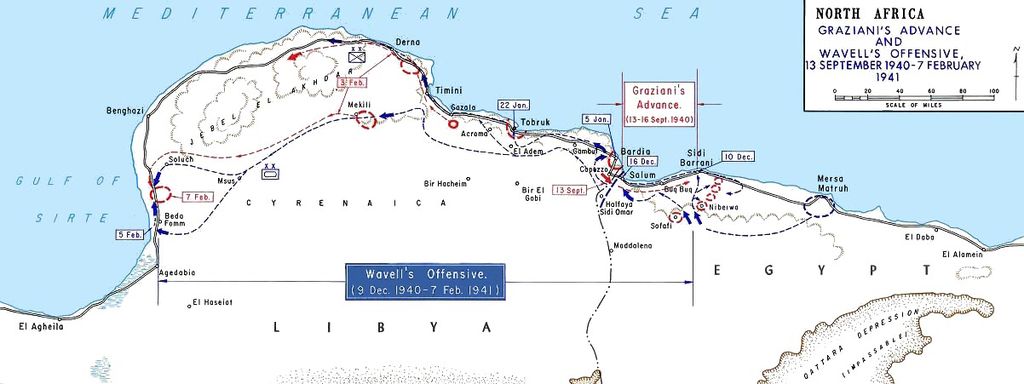
Operation Compass was a military campaign conducted by British forces against the Italian 10th Army in North Africa. The Battle of Beda Fomm marked a critical phase of this operation, where British troops, specifically a mobile unit known as Combe Force from the XIII Corps, successfully executed a maneuver that cut off the retreating Italian forces. This strategic action prevented the Italians from breaking through the British lines, leading to a decisive outcome. The engagement involved several days of intense combat, showcasing the effectiveness of the British forces in exploiting the vulnerabilities of the Italian army. The culmination of this battle resulted in the surrender of approximately 130,000 Italian soldiers, significantly impacting the Italian military presence in North Africa and altering the dynamics of the conflict in the region. The surrender occurred in and around the city of Benghazi, which was a key location during the campaign. This event not only demonstrated the operational capabilities of the British forces but also highlighted the challenges faced by the Italian military, which struggled with logistics and morale during the campaign. The outcome of the Battle of Beda Fomm was a pivotal moment in the North African theater of World War II, contributing to the broader strategic objectives of the Allies in the region.
#mooflife
#MomentOfLife
#OperationCompass
#BattleOfBedaFomm
#Italian10thArmy
#BritishMilitaryHistory
#NorthAfricaCampaign
Primary Reference
Battle of Beda Fomm

Explore the Life Moments of
 AI Twin