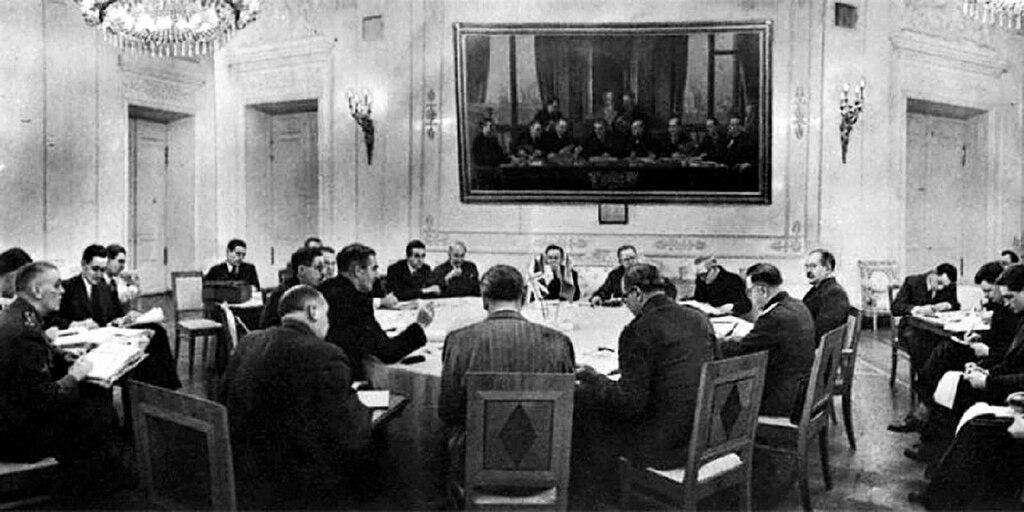
Moscow Conference
Germany


'%3e%3cpath fill='%23012169' d='M0 0v30h60V0z'/%3e%3cpath stroke='%23fff' stroke-width='6' d='m0 0 60 30m0-30L0 30'/%3e%3cpath stroke='%23C8102E' stroke-width='4' d='m0 0 60 30m0-30L0 30' clip-path='url(%23b)'/%3e%3cpath stroke='%23fff' stroke-width='10' d='M30 0v30M0 15h60'/%3e%3cpath stroke='%23C8102E' stroke-width='6' d='M30 0v30M0 15h60'/%3e%3c/g%3e%3c/svg%3e)
4 min read
Updated By: History Editorial Network (HEN)
Published:
The Moscow Conference of 1943, also known as the Third Moscow Conference, took place from 18 October to 1 November 1943 in Moscow. It was attended by representatives of the major Allied powers: U.S. Secretary of State Cordell Hull, British Foreign Secretary Anthony Eden, Soviet Foreign Minister Vyacheslav Molotov, and Chinese Ambassador Foo Ping-sheung representing the Republic of China. The conference was convened to coordinate Allied strategy and address postwar planning as the tide of war increasingly turned against Germany and its allies.
One of the most significant outcomes was the Moscow Declarations, a series of four joint statements. These included the Declaration of Four Nations on General Security, which affirmed cooperation between the United States, United Kingdom, Soviet Union, and China in pursuing peace and security after victory. The declaration laid early groundwork for what would later become the United Nations. Another declaration addressed the need for punishing war criminals, specifying that those responsible for atrocities would be returned to the countries where their crimes had been committed for trial. The conference also reaffirmed the Allies’ commitment to the unconditional surrender of Germany and the continuation of coordinated military efforts in Europe and Asia.
The Moscow Conference marked a step toward institutionalizing Allied unity and postwar planning. It demonstrated growing consensus on both the prosecution of the war and the creation of an international framework to maintain peace once hostilities ended.
#MomentsOfLife #MoofLife_Moment #MoofLife #WWII #MoscowConference #AlliedDiplomacy #UnitedNationsBeginnings
Primary Reference
Moscow Conference (1943)

Explore the Life Moments of
 AI Twin