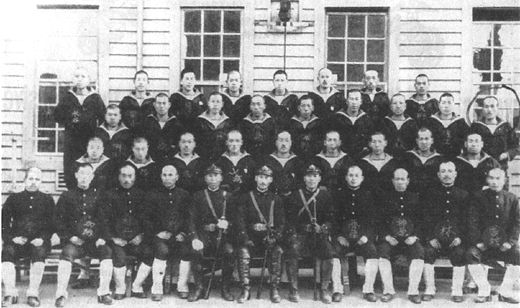
Japanese forces land on Tulagi
Germany

'%3e%3cpath fill='%23012169' d='M0 0v30h60V0z'/%3e%3cpath stroke='%23fff' stroke-width='6' d='m0 0 60 30m0-30L0 30'/%3e%3cpath stroke='%23C8102E' stroke-width='4' d='m0 0 60 30m0-30L0 30' clip-path='url(%23b)'/%3e%3cpath stroke='%23fff' stroke-width='10' d='M30 0v30M0 15h60'/%3e%3cpath stroke='%23C8102E' stroke-width='6' d='M30 0v30M0 15h60'/%3e%3c/g%3e%3c/svg%3e)
'/%3e%3c/defs%3e%3cpath fill='%23012169' d='M0 0h10080v5040H0z'/%3e%3cpath stroke='%23fff' stroke-width='.6' d='m0 0 6 3m0-3L0 3' clip-path='url(%23b)' transform='scale(840)'/%3e%3cpath stroke='%23e4002b' stroke-width='.4' d='m0 0 6 3m0-3L0 3' clip-path='url(%23c)' transform='scale(840)'/%3e%3cpath stroke='%23fff' stroke-width='840' d='M2520 0v2520M0 1260h5040'/%3e%3cpath stroke='%23e4002b' stroke-width='504' d='M2520 0v2520M0 1260h5040'/%3e%3cg fill='%23fff'%3e%3cuse xlink:href='%23d' x='2520' y='3780'/%3e%3cuse xlink:href='%23a' x='7560' y='4200'/%3e%3cuse xlink:href='%23a' x='6300' y='2205'/%3e%3cuse xlink:href='%23a' x='7560' y='840'/%3e%3cuse xlink:href='%23a' x='8680' y='1869'/%3e%3cuse xlink:href='%23e' x='8064' y='2730'/%3e%3c/g%3e%3c/svg%3e)
Military History
World War II
Naval Warfare
4 min read
Updated By: History Editorial Network (HEN)
Published:
Updated:
The landing of Japanese forces on Tulagi marked a crucial step in their strategic plan to capture Port Moresby. Under the command of Admiral Kiyohide Shima, these forces executed unopposed landings on the island, which was part of the Solomon Islands. This operation was significant as it initiated the Battle of the Coral Sea, a pivotal naval engagement in the Pacific Theater during World War II. The Japanese aimed to establish a stronghold in the region, which would facilitate further operations against Allied forces and secure their supply lines. The unopposed nature of the landings indicated a lack of immediate resistance from Allied forces, allowing the Japanese to consolidate their position on Tulagi without facing direct confrontation at that moment.
The impact of this operation was felt across the Pacific, as it set the stage for subsequent military engagements. The Battle of the Coral Sea, which followed shortly after the landings, became the first major naval battle in which aircraft carriers engaged each other, marking a shift in naval warfare tactics. The battle resulted in significant losses for both sides but ultimately halted the Japanese advance towards Port Moresby. This engagement underscored the importance of intelligence and air power in naval operations, influencing future strategies in the Pacific. The landings on Tulagi and the ensuing battle highlighted the escalating conflict between Japanese and Allied forces, shaping the course of the war in the region.
#mooflife
#MomentOfLife
#JapaneseForces
#Tulagi
#BattleOfTheCoralSea
#AdmiralKiyohideShima
#PacificTheater
Primary Reference
Invasion of Tulagi (May 1942)

Explore the Life Moments of
 AI Twin