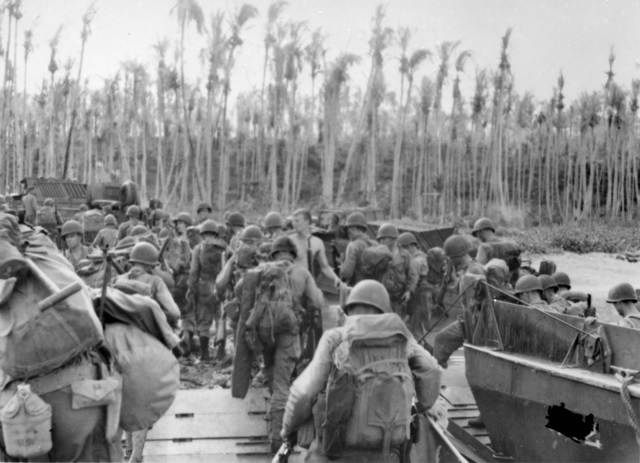
Battle of Arawe
Germany
4 min read
Updated By: History Editorial Network (HEN)
Published:
The Battle of Arawe took place from 15 December 1943 to 24 February 1944 on the southern coast of New Britain in the Southwest Pacific. It was part of General Douglas MacArthur’s strategy to neutralize the major Japanese base at Rabaul through a series of bypassing operations. Arawe, a relatively small peninsula, was selected as a secondary landing site to divert Japanese attention from the main assault planned at Cape Gloucester on the island’s western tip.
The landing was carried out by elements of the U.S. Army’s 112th Cavalry Regiment, supported by naval and air forces. On 15 December 1943, U.S. forces stormed Arawe’s beaches under fire from Japanese coastal defenses. Initial resistance was strong, but the defenders—composed of a few hundred Japanese troops—were quickly overwhelmed. Once established ashore, American troops began constructing a base and airstrip to support further operations.
Although the Japanese launched limited counterattacks and air raids in the weeks that followed, Arawe never became a major battlefield. The most notable engagement occurred on 25 December, when U.S. forces repelled a determined Japanese counterattack with heavy casualties for the attackers. By late February 1944, the battle had effectively ended, and Arawe was secured as a staging point.
While the Battle of Arawe was relatively small compared to other Pacific engagements, it contributed to the isolation of Rabaul by diverting Japanese resources and providing a logistical foothold. It also offered valuable experience in amphibious warfare for U.S. forces.
#MomentsOfLife #MoofLife_Moment #MoofLife #WWII #Arawe #PacificWar #NewBritain #IslandHopping
Primary Reference
Battle of Arawe

Explore the Life Moments of
 AI Twin