Allies land on Bougainville
Germany


'/%3e%3c/defs%3e%3cpath fill='%23012169' d='M0 0h10080v5040H0z'/%3e%3cpath stroke='%23fff' stroke-width='.6' d='m0 0 6 3m0-3L0 3' clip-path='url(%23b)' transform='scale(840)'/%3e%3cpath stroke='%23e4002b' stroke-width='.4' d='m0 0 6 3m0-3L0 3' clip-path='url(%23c)' transform='scale(840)'/%3e%3cpath stroke='%23fff' stroke-width='840' d='M2520 0v2520M0 1260h5040'/%3e%3cpath stroke='%23e4002b' stroke-width='504' d='M2520 0v2520M0 1260h5040'/%3e%3cg fill='%23fff'%3e%3cuse xlink:href='%23d' x='2520' y='3780'/%3e%3cuse xlink:href='%23a' x='7560' y='4200'/%3e%3cuse xlink:href='%23a' x='6300' y='2205'/%3e%3cuse xlink:href='%23a' x='7560' y='840'/%3e%3cuse xlink:href='%23a' x='8680' y='1869'/%3e%3cuse xlink:href='%23e' x='8064' y='2730'/%3e%3c/g%3e%3c/svg%3e)
4 min read
Updated By: History Editorial Network (HEN)
Published:
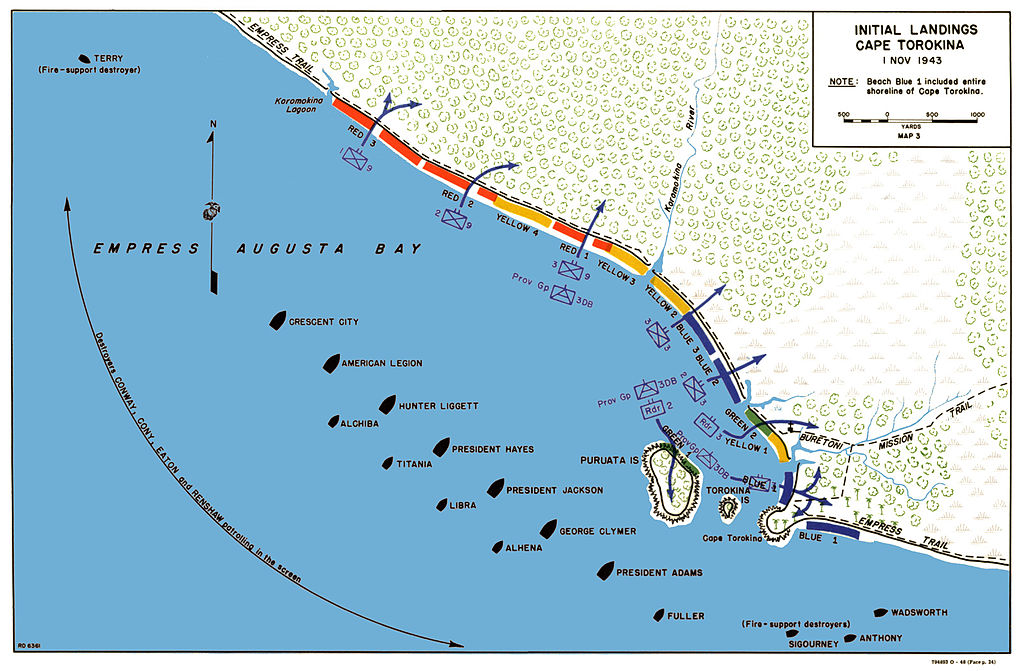
On 1 November 1943, Allied forces launched an amphibious landing on Bougainville, the largest island in the Solomon Islands chain, as part of the wider campaign to isolate and neutralize the Japanese stronghold at Rabaul on New Britain. The operation, codenamed Operation Cherry Blossom, was carried out by U.S. Marines of the I Marine Amphibious Corps under Major General Alexander A. Vandegrift. Supported by naval gunfire and carrier-based aircraft, the landings took place at Cape Torokina on the island’s western coast.
Japanese forces on Bougainville, numbering approximately 40,000 troops under General Harukichi Hyakutake, were widely dispersed and initially unprepared for the concentrated U.S. assault. The beachhead was quickly secured, though fighting intensified in subsequent weeks as Japanese units attempted counterattacks. The terrain—dense jungle, swamps, and mountains—posed significant logistical challenges for both sides. Despite heavy resistance, the Allies maintained control of the landing area and began constructing airfields. These air bases became crucial in the campaign to strike Rabaul, effectively reducing its ability to function as a major Japanese base without a costly direct assault.
The Bougainville operation exemplified the Allied strategy of “island hopping,” bypassing heavily fortified positions while securing strategically valuable sites. The campaign lasted until the end of the war, with U.S. forces later replaced by Australian troops who continued operations against entrenched Japanese units.
The landing on Bougainville was a key step in the encirclement of Rabaul and contributed significantly to the eventual collapse of Japanese defenses in the South Pacific.
#MomentsOfLife #MoofLife_Moment #MoofLife #WWII #Bougainville #PacificWar #IslandHopping #AlliedOffensive
Primary Reference
Landings at Cape Torokina

Explore the Life Moments of
 AI Twin