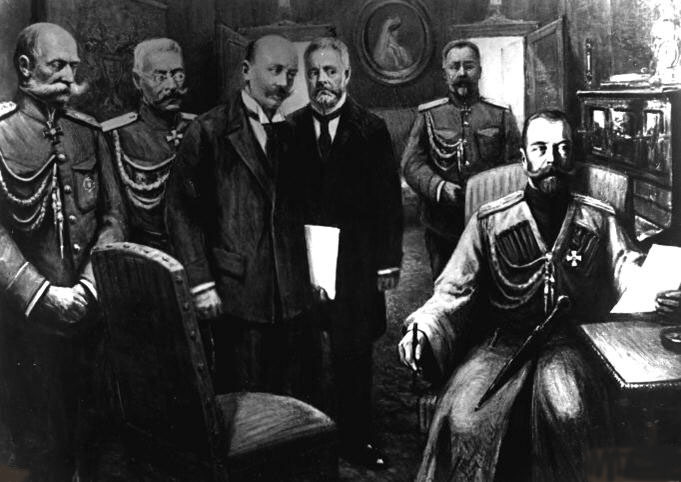
Russian Revolution: Tsar Nicholas II abdicates, Provisional Government forms amidst internal strife.
Germany
Political
Global Trade
5 min read
Updated By: History Editorial Network (HEN)
Published:
Updated:
Amidst the turbulent backdrop of World War I, Russia faced escalating internal strife and public discontent. The country, already burdened by the strains of prolonged conflict, experienced severe food shortages, economic stagnation, and widespread dissent among its population. The dire circumstances precipitated a pivotal transition in Russian history: Tsar Nicholas II's abdication of the throne.
Under immense pressure from military officials and revolutionaries, Nicholas II decided to relinquish power. His abdication marked the cessation of Romanov rule, which had spanned over three centuries. This dramatic shift brought about the formation of the Provisional Government, intended to stabilize the nation and address the urgent wartime needs.
The Provisional Government, comprising various political factions, pledged to maintain Russia's involvement in World War I, hoping to honor alliances and mitigate external threats. However, this commitment only exacerbated the turmoil within the nation. The continuation of military engagement failed to assuage the hardships of the Russian populace, who demanded peace, food, and land reforms.
Key figures involved in the Provisional Government included Alexander Kerensky, who assumed a prominent leadership role. Despite initial support, the government's inability to address critical socio-economic issues and its reliance on outdated governance structures led to widespread dissatisfaction. This discontent eventually paved the way for the Bolshevik Revolution, which further reshaped Russia’s political landscape.
Statistically, the period saw significant losses for Russia on the battlefield, with millions of military casualties and substantial economic costs. The societal upheaval underscored the fragility of the Russian state as it grappled with internal and external pressures.
This phase of Russian history is marked by profound transformations, setting the stage for the emergence of the Soviet Union. The abdication not only symbolized the end of Romanov rule but also highlighted the complexities of wartime governance and the intricate interplay between domestic demands and international obligations.
#EndOfRomanovs #ProvisionalGovernment #RussianRevolution #WorldWarI #MoofLife
Explore the Life Moments of
 AI Twin