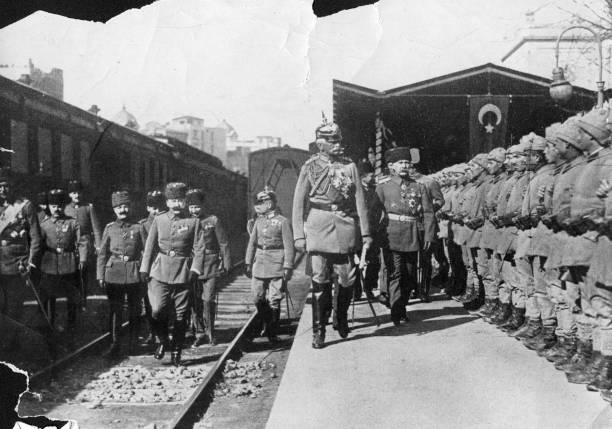
Germany and Ottoman Empire forge secret alliance to counterbalance Russia in World War I.
Germany
Political
Military
4 min read
Updated By: History Editorial Network (HEN)
Published:
Updated:
At a critical juncture in the lead-up to World War I, Germany and the Ottoman Empire signed a secret alliance, intending to counterbalance the influence of Russia and its allies. The geopolitical landscape was fraught with tensions, as various national powers were forming strategic partnerships. Both Germany and the Ottoman Empire had vested interests in undermining Russian power; Germany sought to neutralize the Eastern Front while the Ottoman leadership aimed to protect its territories and regain former prestige.
The secret agreement stipulated military cooperation and economic support between the two empires. This alliance bolstered Germany's strategic advantage, facilitating a two-front conflict that could stretch Russian resources. For the Ottoman Empire, the pact promised a solid ally in the face of encroaching Russian influence in the Caucasus and Balkans.
This alliance had a substantial impact on the dynamics of World War I. Their combined forces contributed to prolonged and bloody campaigns, most notably in the Middle Eastern theatre where the Ottoman forces, supported by German military expertise, engaged British and Russian troops. It also influenced other regional players, shifting alliances and prompting a recalibrated approach to military strategies on both sides.
The alliance significantly affected resource allocation and troop movements, demonstrating the importance of diplomatic maneuvers in wartime strategies. Despite the ultimate defeat of the Central Powers, the early advantages obtained through such pacts shaped key battles and prolonged the conflict.
#WorldWarI #OttomanEmpire #Germany #SecretAlliance #MoofLife
Primary Reference
Alliance System 1914 / 1.0 / handbook - 1914-1918-Online (WW1 ...
Explore the Life Moments of
 AI Twin