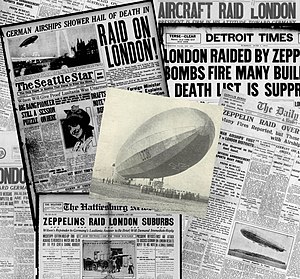
German Zeppelin raid on London shifts warfare; civilians targeted, casualties and damage inflicted.
Germany
Military
War
5 min read
Updated By: History Editorial Network (HEN)
Published:
Updated:
The inaugural German Zeppelin raid on London marked a pivotal shift in the nature of warfare during World War I. Previously, battles had largely been confined to the front lines, but the advent of this raid expanded the scope of the conflict to include civilian populations.
On this historic day, German Navy Zeppelins, LZ 38 and LZ 39, embarked on a bombing mission targeting the British capital. Departing from their base in Belgium, the airships carried an assortment of high-explosive and incendiary bombs. Their primary objective was to bring the war to British civilians, disrupting morale and causing fear among the population.
The attack resulted in significant damage and casualties. The bombs dropped by LZ 38 in particular resulted in the deaths of seven people and injuries to thirty-five others. Additionally, extensive property damage occurred, with several buildings set ablaze by the incendiary bombs. The raid demonstrated the vulnerabilities of urban centers to aerial assaults and underscored the destructive capacity of Zeppelins in warfare.
The psychological impact of the raid was substantial. Civilians, who had hitherto been spectators to the distant fighting across the English Channel, were now directly confronted with the horrors of war. Public sentiment shifted, and there was an increased demand for improved air defenses and retaliatory measures. The raid also spurred advancements in anti-aircraft technology and the development of home defense strategies, including the construction of bomb shelters and the implementation of air raid drills.
In military terms, the raid highlighted the strategic advantage of airships, which could bypass traditional defenses and deliver their payloads with relative impunity. It further compelled the British military to innovate and adapt, leading to the eventual deployment of fighter aircraft specifically designed to counter the Zeppelin threat.
Overall, this event underscored the expanding nature of modern warfare, where technological advancements enabled new forms of combat that blurred the lines between the front lines and the home front.
#WWI #AerialWarfare #ZeppelinRaid #LondonHistory #MilitaryInnovation #MoofLife
Primary Reference
When war came home: air-raid shock in World War I - PMC

Explore the Life Moments of
 AI Twin