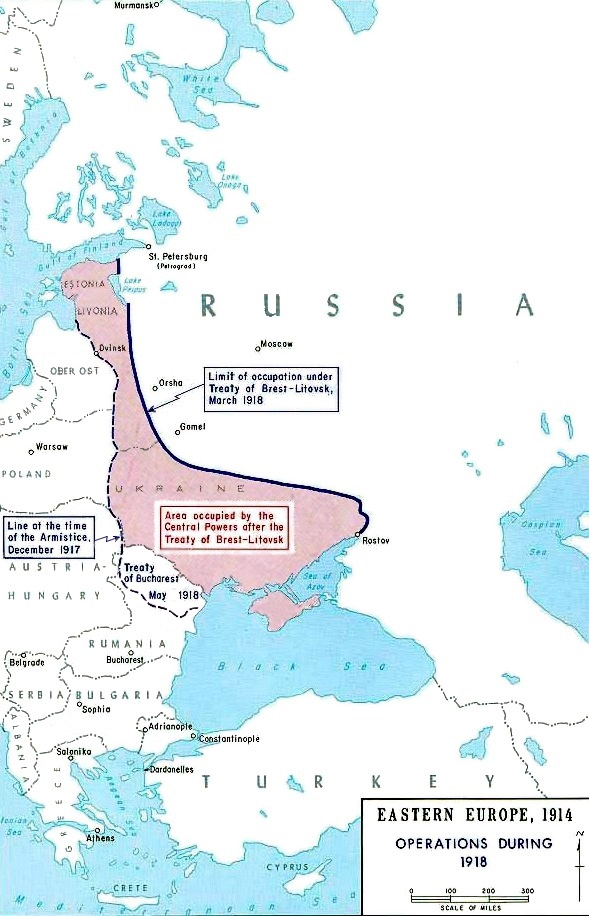
German Operation Faustschlag: Swift advance and territorial gains in Soviet Russia during World War I.
Germany
Political
Global Trade
4 min read
Updated By: History Editorial Network (HEN)
Published:
Updated:
During World War I, German forces advanced swiftly into Soviet territory, seizing key cities and penetrating deep into Russian-held lands in a campaign known as Operation Faustschlag. This military operation, carried out after the collapse of peace negotiations between the Central Powers and Soviet Russia, aimed to force the Soviets back to the bargaining table under more favorable terms for Germany.
The German army's rapid movement was facilitated by the disarray and weakening of the Bolshevik government, which had recently taken control following the October Revolution. The Soviet forces were ill-prepared and poorly equipped to counter the well-organized and experienced German troops. As a result, the Germans captured significant territories, including key strategic locations such as Dvinsk, Minsk, and the Black Sea port of Odessa.
Operation Faustschlag, also known as the Eleven Days War, resulted in Germany taking control of vast stretches of land reaching hundreds of miles into what was then Soviet territory. The operation significantly pressured the Soviet government, ultimately leading to the signing of the Treaty of Brest-Litovsk. This treaty marked Russia's exit from World War I but at the cost of substantial territorial concessions to the Central Powers.
The operation further exemplified the chaotic state of post-revolutionary Russia and underscored the tactical prowess of the German military. It altered the eastern front's dynamics and shifted the geopolitical landscape, impacting the post-war arrangements and the future of Eastern Europe.
#WWI #OperationFaustschlag #MoofLife #MilitaryHistory #EasternFront #GermanAdvance #BrestLitovsk #RussianRevolution
Primary Reference
Operation Faustschlag - Wikipedia

Explore the Life Moments of
 AI Twin