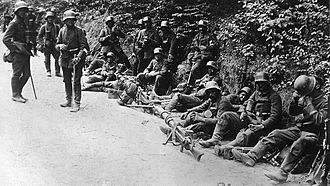
Devastating defeat at Caporetto in World War I leads to Italian military changes.
Germany
Military
4 min read
Updated By: History Editorial Network (HEN)
Published:
Updated:
The Battle of Caporetto, also referred to as the Twelfth Battle of the Isonzo, marked a critical military engagement during World War I when German and Austro-Hungarian forces initiated a substantial offensive against the Italian Army. The Central Powers deployed innovative infiltration tactics, including the use of storm troops and gas attacks, which overwhelmed the Italian defenders. The offensive focused on breaking through at a weak point in the Italian front lines along the Isonzo River.
The impact of this offensive was devastating for Italy. The Italian Second Army suffered heavy losses, with tens of thousands of soldiers killed, wounded, or taken prisoner. The Italian lines collapsed, leading to a chaotic and hasty retreat. In total, Italian casualties amounted to approximately 300,000, while German and Austro-Hungarian forces sustained comparatively lighter losses.
The Italian High Command struggled to maintain order among the retreating troops. The advance of the Central Powers forced the Italians to retreat over 150 kilometers to the Piave River, a distance they hoped to defend more effectively. This retreat significantly weakened Italian morale and military strength, compelling the Allies to send reinforcements to stabilize the front. The defeat at Caporetto exposed severe deficiencies in Italian military leadership and preparedness, sparking changes in the Italian command structure, including the replacement of General Luigi Cadorna with General Armando Diaz. These events had profound consequences on the broader conflict, as they necessitated the reallocation of Allied resources and affected the strategic considerations on the Italian Front.
#BattleOfCaporetto #Isonzo #WorldWarI #MilitaryHistory #WWI #MoofLife
Primary Reference
Italian Front

Explore the Life Moments of
 AI Twin