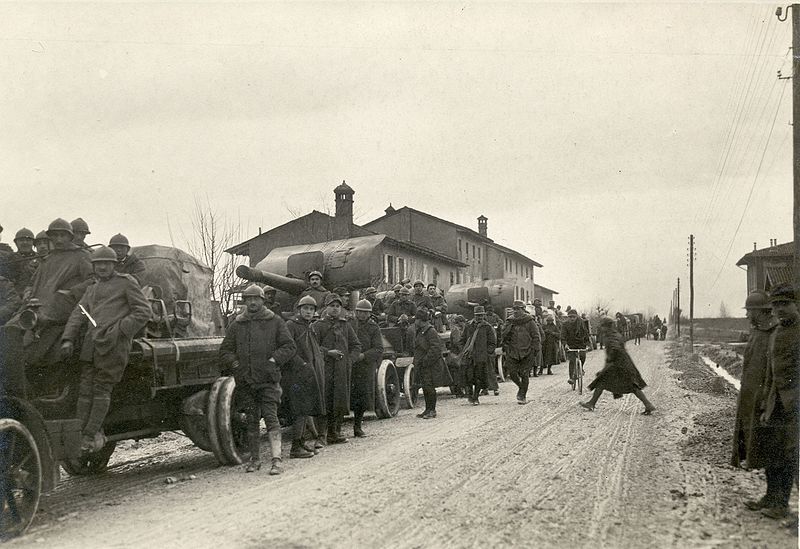
Caporetto Offensive: Central Powers breakthrough prompts Italian retreat, shifting World War I strategies.
Germany
Military
4 min read
Updated By: History Editorial Network (HEN)
Published:
Updated:
In the later stages of World War I, German and Austro-Hungarian forces launched a coordinated offensive against the Italian army at Caporetto. This strategic assault was characterized by the use of innovative infiltration tactics and efficient coordination between the Central Powers. Faced with intense artillery bombardment and fast-moving stormtrooper units, the Italian lines rapidly collapsed. The breakthrough led to significant Italian casualties, both in terms of killed and wounded soldiers, as well as a substantial number of prisoners taken by the Central Powers.
The Italian forces, under severe pressure, were compelled to retreat from the frontlines at Caporetto, moving towards a more defensible position along the Piave River. This retreat marked a pivotal shift in the Italian Front, as the loss at Caporetto significantly altered the morale and strategic standing of the Italian military. It forced the Italian command to overhaul their defensive strategies and fortify their remaining positions to stave off further advances by the Central Powers.
The battle had wide-ranging impacts on the course of World War I. It highlighted the effectiveness of new military strategies and underscored the vulnerability of traditional defensive lines without proper adaptation to evolving tactics. Additionally, the Italian retreat necessitated a reallocation of Allied resources and support to stabilize the front and prevent further incursions.
#MoofLife #WWI #Caporetto #MilitaryStrategy #HistoricalBattles
Primary Reference
Italian Front

Explore the Life Moments of
 AI Twin