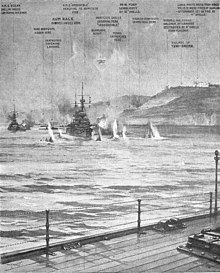
Allied naval assault on Dardanelles: Strategic failure with lasting impact on World War I.
Germany
Political
Military
4 min read
Updated By: History Editorial Network (HEN)
Published:
Updated:
During one phase of World War I, the Allied powers launched a naval assault on the Dardanelles Strait, a strategic waterway controlled by the Ottoman Empire. The primary objective was to weaken Ottoman defenses and secure a sea route to Russia, an ally in desperate need of supplies. British and French warships spearheaded the operation, aiming to force their way through the heavily fortified strait.
This military action was met with fierce resistance from the Ottoman forces, who had fortified the Dardanelles with mines, artillery, and other defensive measures. Despite the formidable Allied fleet, several warships fell victim to submerged mines and relentless artillery fire. Notable ships, including the British battleships HMS Irresistible and HMS Ocean, as well as the French battleship Bouvet, were sunk during the confrontation. The severe losses and the strong Ottoman defense compelled the Allied forces to halt their campaign temporarily.
The failure of this naval assault had significant repercussions for the Allied strategy. It highlighted the underestimation of Ottoman military capabilities and led to a reconsideration of tactics. The need for a prolonged and more comprehensive campaign became apparent, eventually leading to the broader Gallipoli Campaign. This moment also underscored the importance of intelligence and preparation in conducting military operations.
The repercussions of this event were far-reaching, influencing the dynamics of World War I and the subsequent military engagements in the region. #MoofLife #WWI #NavalWarfare #Dardanelles #MilitaryHistory
Primary Reference
Naval operations in the Dardanelles campaign - Wikipedia

Explore the Life Moments of
 AI Twin