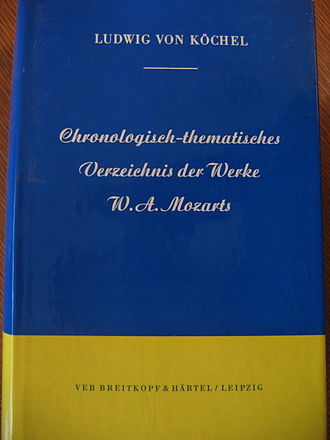
The Köchel Catalogue: Organizing Mozart's Works for Accessibility and Understanding
Vienna, Austria
Musicology
8 min read
Updated By: History Editorial Network (HEN)
Published:
Updated:
In 1862, Austrian scholar Ludwig von Köchel published the first edition of the Köchel catalogue, formally titled Chronologisch-thematisches Verzeichnis sämtlicher Tonwerke Wolfgang Amadé Mozarts. This work introduced a systematic method for organizing the compositions of Wolfgang Amadeus Mozart into a chronological sequence. Before Köchel’s effort, Mozart’s extensive body of work lacked a unified cataloging system, making it difficult for scholars, performers, and publishers to identify and reference individual compositions consistently.
Köchel, who had backgrounds in musicology, botany, and mineralogy, undertook years of detailed research to compile the catalogue. He examined manuscripts, early editions, correspondence, and historical records to determine approximate dates of composition. The result was a list of more than 600 works, each assigned a unique Köchel number, commonly abbreviated as “K.” or “KV.” This numbering system allowed Mozart’s works, including symphonies, operas, chamber music, and sacred compositions, to be identified with clarity and consistency across academic and performance contexts.
The catalogue provided more than a simple index. By arranging the works chronologically, Köchel created a framework through which Mozart’s musical development could be studied over time. Scholars were able to trace stylistic changes, compositional techniques, and periods of productivity throughout Mozart’s life. The catalogue also brought attention to lesser-known works that had previously been overlooked or misattributed.
Over time, the Köchel catalogue has undergone several revisions as new research refined the dating and authenticity of certain works. Despite these updates, the original numbering system remains widely used in concert programs, recordings, and scholarly literature. Köchel’s 1862 publication established a lasting standard for cataloging classical music, influencing how the works of other composers have been organized and studied.
● Ludwig von Köchel introduced the Köchel catalogue to systematically organize the works of Mozart in a chronological sequence. Prior to this effort, the works of the prolific composer were dispersed without a coherent system. Köchel, an Austrian musicologist and botanist, embarked on this ambitious task to bring order and accessibility to Mozart's compositions.
Engaging in extensive research, Köchel meticulously categorized over 600 works by Mozart, ranging from symphonies and operas to chamber music. Each piece was assigned a unique number known as the Köchel (K.) number, allowing for a standardized reference across the musical community. This cataloging provided a valuable framework for scholars and musicians, simplifying the process of locating and studying Mozart's compositions.
The Köchel catalogue facilitated a deeper understanding of Mozart's developmental trajectory as a composer. It revealed patterns and progression in his musical style and highlighted previously overlooked works. This system not only aided in preserving Mozart's legacy but also influenced how other composers' repertories were organized and studied.
Through Köchel's scholarly efforts, Mozart's contributions to classical music were more readily accessible to performers and audiences. The organized presentation of his works encouraged wider dissemination and performance, reinforcing Mozart's impact on the musical canon.
#MoofLife #Mozart #Musicology #ClassicalMusic #MusicHistory #ScholarlyWork #Catalogue #MusicResearch
#Mozart
#KöchelCatalogue
#ClassicalMusic
#MusicHistory
#Musicology
Primary Reference
Köchel catalogue
Explore the Life Moments of
 AI Twin