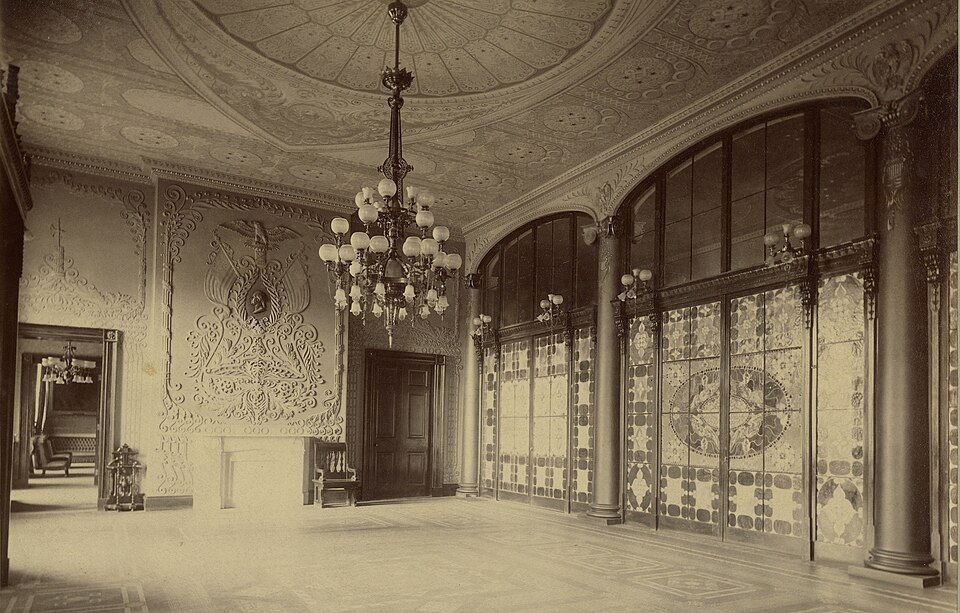
The White House Entrance Hall Featuring the Tiffany Glass Screen
United States of America
Architecture,
5 min read
Updated By: History Editorial Network (HEN)
Published:
In 1890, the White House Entrance Hall in Washington, D.C., featured an elaborate stained-glass screen created by the decorative arts firm of Louis Comfort Tiffany, one of the most distinctive elements of the presidential residence's late 19th-century interior. The screen had been installed during the administration of President Chester A. Arthur as part of an extensive redecoration carried out in 1882. Positioned between the Entrance Hall and the Cross Hall, it transformed the appearance of the main public entrance and remained in place throughout the following decade.
President Arthur commissioned Louis Comfort Tiffany and his associates to redecorate several White House rooms. The work reflected contemporary Victorian tastes, introducing stronger colors, decorative patterns, and elaborate furnishings. Tiffany's glass screen replaced an earlier partition in the Entrance Hall. Its colored and opalescent glass panels were arranged within a decorative framework, creating a visual division between the Entrance Hall and the long Cross Hall beyond it.
Photographs from around 1890 preserve the appearance of the Entrance Hall with the Tiffany screen in place. Visitors entering through the White House's north entrance encountered the screen as part of the sequence leading into the principal-floor public rooms. The installation existed during the presidency of Benjamin Harrison, who served from 1889 to 1893, although the screen itself dated from Arthur's administration several years earlier.
The Tiffany interior did not survive the extensive White House renovation undertaken during Theodore Roosevelt's presidency. In 1902, the architectural firm McKim, Mead & White remodeled the presidential residence and removed many Victorian-era decorative features in an effort to establish a different architectural character for the interiors. Tiffany's Entrance Hall screen was removed during that work and was later destroyed in a fire while in storage.
Historical Significance: The 1890 view documents a White House interior that no longer exists and records the Victorian decorative scheme introduced under Chester A. Arthur. The Tiffany screen is particularly well documented through surviving photographs, allowing the appearance of this lost element of the White House to remain part of its architectural record.
#WhiteHouse
#LouisComfortTiffany
#TiffanyGlass
#EntranceHall
#ChesterAArthur
#BenjaminHarrison
#VictorianArchitecture
#WashingtonDC
#1890
#AmericanHistory
Primary Reference
White House

Explore the Life Moments of
 AI Twin