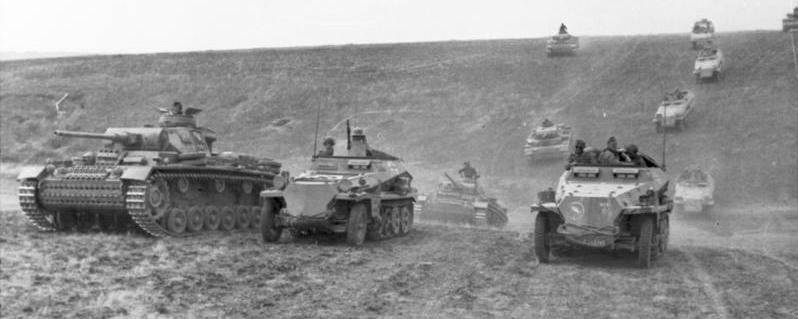
German Panzer Divisions Pioneer Blitzkrieg Warfare Rapid armored assaults supported by air power shock the Allies.
4 min read
Updated By: History Editorial Network (HEN)
Published:
German Panzer divisions played a central role in pioneering the Blitzkrieg ("lightning war") strategy that defined the early years of World War II. These mechanized units, built around fast-moving tanks and supported by motorized infantry, engineers, and artillery, were designed to strike hard and deep into enemy territory. Unlike traditional warfare, which emphasized slow advances and static defenses, Blitzkrieg relied on speed, surprise, and concentrated force to break through enemy lines and encircle them rapidly. The Panzer divisions, with their well-coordinated armor assaults, served as the spearhead of this strategy. Their effectiveness was dramatically demonstrated during the invasions of Poland (1939), France (1940), and the early stages of Operation Barbarossa (1941).
A key component of Blitzkrieg was the close coordination between ground forces and the Luftwaffe, Germany’s air force. Dive bombers like the Ju 87 Stuka were used to soften enemy defenses and disrupt communications ahead of the advancing Panzers, creating panic and disorganization. This combination of armored speed and air superiority overwhelmed traditional defensive strategies and left the Allies struggling to respond. Though initially unstoppable, the Blitzkrieg model eventually met its limits—especially in the vast, rugged terrain of the Soviet Union and against improving Allied tactics. Still, German Panzer divisions remain a historic example of how innovation in mobility, coordination, and firepower can redefine warfare.
\#MomentsOfLife #MoofLife\_Moment #MoofLife #Blitzkrieg #PanzerDivisions #WWIIHistory #MilitaryInnovation #ArmoredWarfare

Explore the Life Moments of
 AI Twin