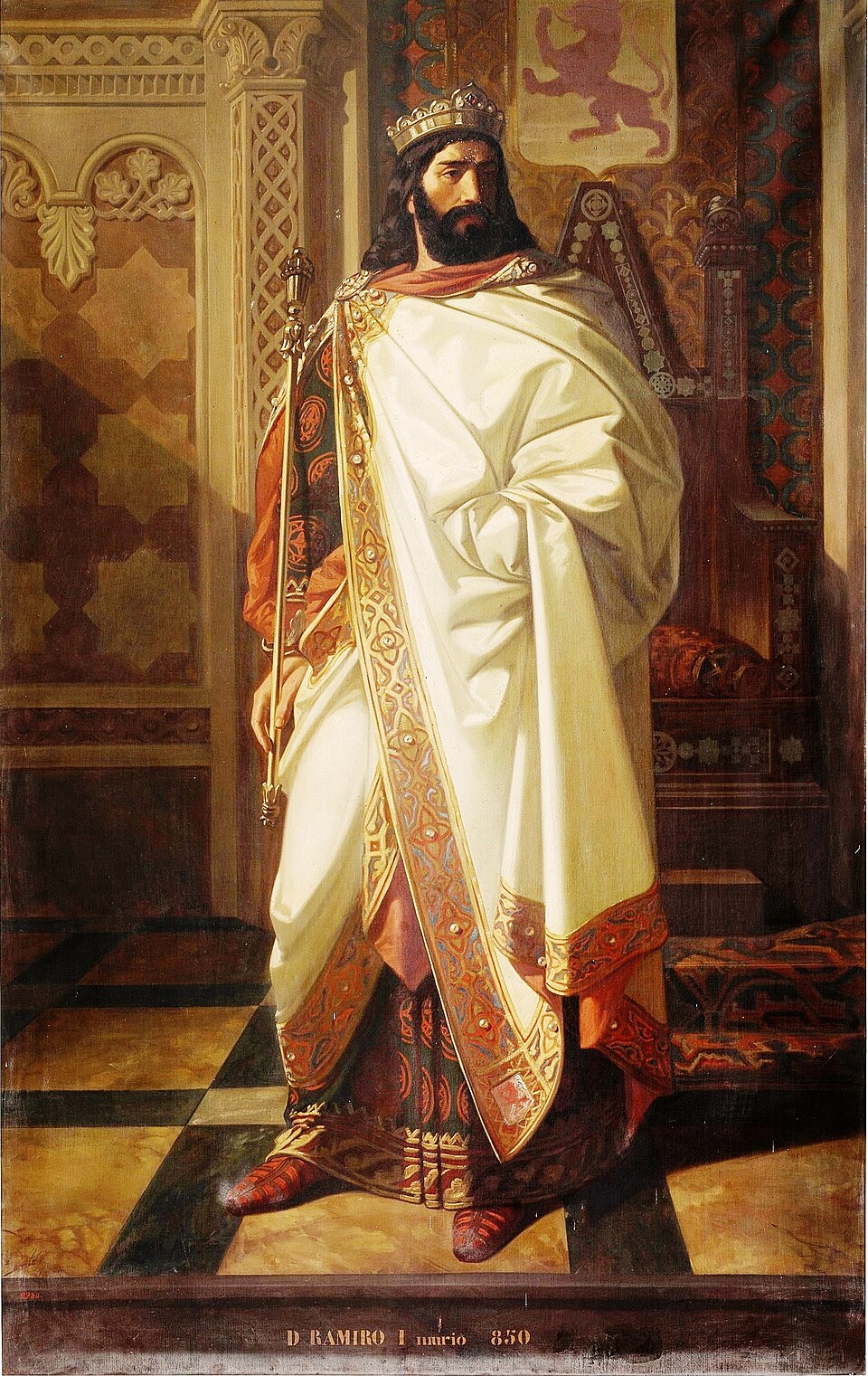
Ramiro was buried in the Pantheon of Asturian Kings in Oviedo, and was succeeded by his son Ordoño I.
Santa María del Naranco, Mount Naranco, near Oviedo, Asturias, Spain
People & Culture
Political & Governance
6 min read
Updated By: History Editorial Network (HEN)
Published:
Updated:
On 01/02/850, Ramiro I, King of Asturias, died at his recreational palace of Santa María del Naranco on Mount Naranco near Oviedo, bringing to an end a reign that had begun in 842. His death marked a dynastic transition in the Asturian kingdom, as his son Ordoño I succeeded him on the same day. Ordoño’s accession is recorded as the first direct hereditary succession in the Kingdom of Asturias, rather than the earlier practice of selection or acclamation among members of the royal lineage.
Ramiro I had ruled during a formative period of the Asturian monarchy in the early stages of the Christian kingdoms in the Iberian Peninsula. His reign included military campaigns against internal revolts and external threats, as well as the construction of notable pre Romanesque monuments near Oviedo. The palace of Santa María del Naranco, originally built as a royal residence, survives today as one of the best preserved examples of Asturian architecture from the 9th century.
Following his death, Ramiro I was buried in the Pantheon of Asturian Kings within the Cathedral of San Salvador in Oviedo. He was laid to rest in a stone sepulcher alongside his second wife, Paterna. The tomb, which no longer survives in its original form, was positioned next to that of his predecessor, Alfonso II. His burial inscription, written in Latin, read: “Obiit divae memoriae Ranimirus Rex die Kal. Februarii. Era DCCCLXXXVIII.” The date corresponds to the Spanish Era year 888, equivalent to 850 AD in the modern calendar.
The death of Ramiro I on 01/02/850 and the immediate succession of Ordoño I represent a documented moment in the consolidation of hereditary monarchy in early medieval Asturias, centered in Oviedo, which served as the political and religious capital of the kingdom.
Ramiro, the King of Asturias, passed away on this day in history, leaving behind a legacy that would shape the future of Spain. Known for his military victories and efforts to unite the Christian kingdoms against the Muslim rulers, his death marked the end of his reign and the beginning of a new era. It was a significant moment as it paved the way for his son, Ordoño I, to ascend to the throne and continue his father's work. Ramiro's burial in the Pantheon of Asturian Kings in Oviedo solidified his place in history and his importance in the Asturian monarchy. His reign was marked by a period of stability and expansion, as he fought to protect his people from Muslim invasions and establish Christian rule. His death was mourned by the people of Asturias and marked the passing of a powerful ruler who had devoted his life to defending his kingdom.
#Spain #Asturias #Kingdom #Legacy
#Ramiro-I
#RamiroI
#KingdomOfAsturias
#Oviedo
#AsturianMonarchy
#MedievalHistory
Primary Reference
BHB - Bar Hbr Bankshares | AcronymAttic
Explore the Life Moments of
 AI Twin