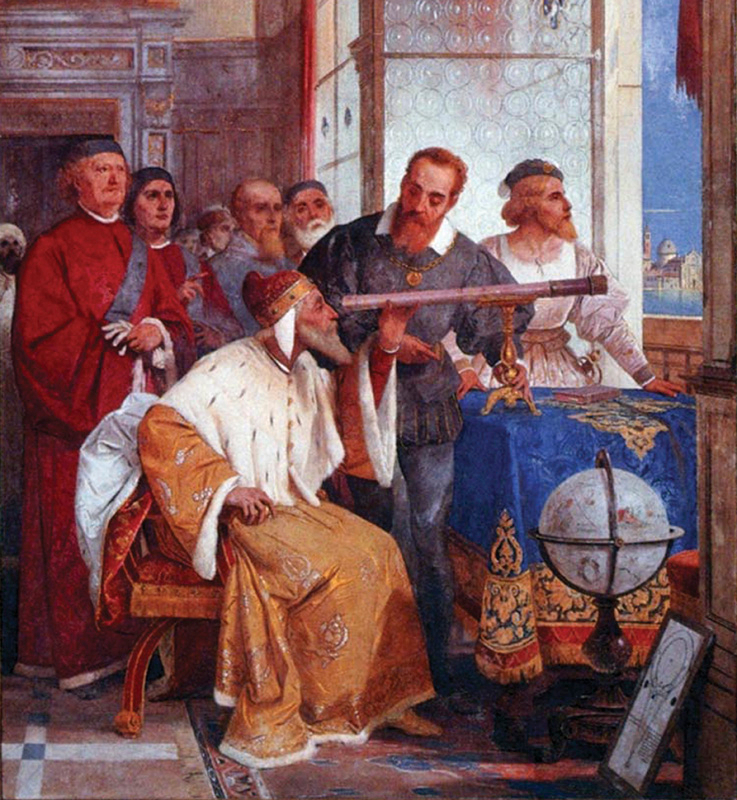
First telescopic observation of the night sky
Padua, Republic of Venice, Italy
Astronomy
History of Science
Physics
4 min read
Updated By: History Editorial Network (HEN)
Published:
Updated:
In 1610, Galileo Galilei conducted the first systematic astronomical observations using an improved telescope, providing direct evidence that challenged long-standing views of the universe. By refining a Dutch-designed spyglass to achieve magnification of about 20x to 30x, Galileo was able to observe celestial objects in unprecedented detail. His findings were published in March 1610 in Sidereus Nuncius (Starry Messenger), presenting observational data that supported the heliocentric model proposed by Nicolaus Copernicus.
One of Galileo’s earliest discoveries came on 07/01/1610, when he observed three small points of light near Jupiter. By 15/01/1610, after tracking their movement, he concluded that these were moons orbiting Jupiter, now known as Io, Europa, and Ganymede, with Callisto identified shortly after. This marked the first recorded observation of celestial bodies orbiting an object other than Earth. Galileo also studied the Moon and found its surface to be uneven, with mountains, craters, and valleys, contradicting the prevailing belief that celestial bodies were perfectly smooth.
Later in 1610, Galileo observed the phases of Venus, noting that the planet exhibited a full set of phases similar to the Moon. This observation was incompatible with the geocentric model and supported the idea that Venus orbits the Sun. He also examined the Milky Way, determining that it consisted of a vast number of faint stars rather than a continuous luminous cloud. Additionally, his observations of sunspots revealed that the Sun rotates and is not a perfect, unchanging sphere.
Galileo’s work provided measurable, visual evidence that contributed to a shift in astronomical understanding during the early modern period. His observations played a central role in the acceptance of heliocentrism and influenced the development of modern scientific methods based on observation and experimentation.
#mooflife
#MomentOfLife
#GalileoGalilei
#TelescopicObservation
#Astronomy
#GalileanMoons
#ScientificRevolution
Primary Reference
Galileo Galilei

Explore the Life Moments of
 AI Twin