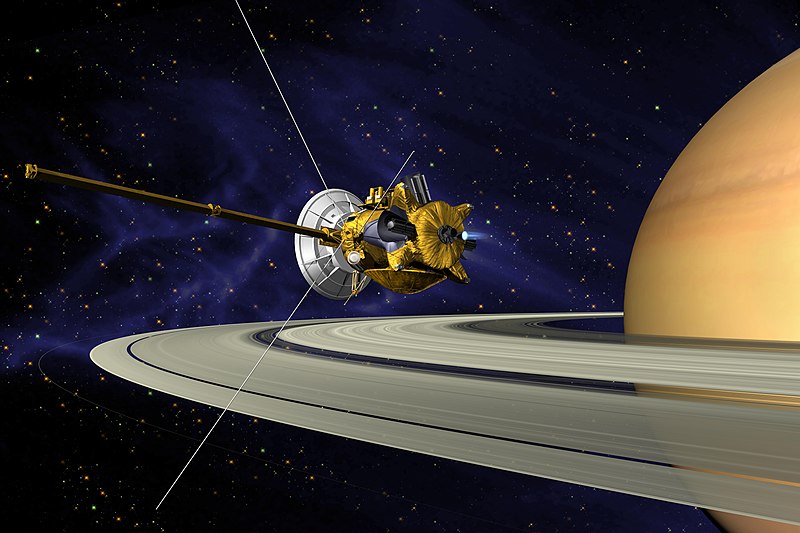
First images of structures in planetary rings
Saturn Ring System
Space Exploration
Astronomy
Planetary Science
4 min read
Updated By: History Editorial Network (HEN)
Published:
Updated:
On 11/08/2009, NASA’s Cassini spacecraft captured images showing vertical structures rising above Saturn’s rings, a discovery made possible during Saturn’s equinox. At equinox, the Sun shines edge on to the ring plane, creating low angle illumination that highlights features normally difficult to detect. Because Saturn’s rings are typically only about 10 meters thick, even small protrusions cast long shadows under these lighting conditions. Cassini’s cameras recorded elongated shadows stretching across the rings, indicating the presence of structures extending significantly above and below the ring plane.
Analysis of the images showed that some of these vertical features reached heights of up to several kilometers, particularly near the edges of gaps such as the Keeler Gap. Scientists linked these structures to gravitational disturbances caused by small embedded moonlets within the rings. These moonlets disturb surrounding ring particles, creating waves and clumps that extend vertically. The equinox geometry allowed Cassini to observe these features clearly for the first time, providing new information about ring thickness and internal dynamics.
The observations improved understanding of how Saturn’s rings evolve and how small moons interact with ring material. By measuring shadow lengths, researchers estimated the height of the structures and confirmed that the rings are not perfectly flat. The 11/08/2009 equinox offered a rare opportunity, as Saturn’s equinox occurs roughly every 15 Earth years. Cassini continued monitoring the rings during this period, capturing additional images that documented changing structures and particle interactions.
#mooflife
#MomentOfLife
#CassiniHuygens
#SaturnRings
#PlanetaryScience
#Exoplanets
#Nasa
Primary Reference
Cassini–Huygens

Explore the Life Moments of
 AI Twin