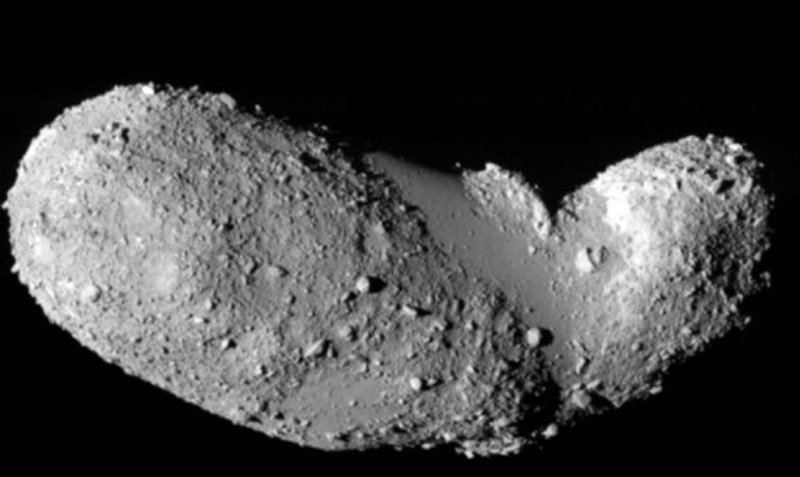
First asteroid ascent and interplanetary escape
Asteroid 25143 Itokawa, Near Earth Space
Space Exploration
Astrophysics
Aerospace Engineering
3 min read
Updated By: History Editorial Network (HEN)
Published:
Updated:
On 19/11/2005, Japan’s Hayabusa spacecraft became the first mission to successfully ascend from the surface of an asteroid after touching down on near Earth asteroid 25143 Itokawa. The spacecraft, developed by the Japan Aerospace Exploration Agency, conducted the touchdown at approximately 21:30 UTC. After briefly contacting the surface, Hayabusa initiated ascent at about 21:58 UTC, moving away from the asteroid and returning to a safe hovering position. The maneuver marked the first time a spacecraft landed on and then took off from an asteroid.
Itokawa is an S type asteroid measuring roughly 550 meters by 180 meters with extremely weak gravity. Hayabusa approached slowly and used autonomous navigation during descent. The spacecraft briefly contacted the surface to attempt sample collection before firing thrusters to ascend. The successful ascent confirmed that controlled landing and departure operations were possible on very small bodies. This capability was essential for the mission’s goal of collecting and returning asteroid material to Earth.
Hayabusa conducted a second touchdown attempt on 25/11/2005 before departing Itokawa. Despite technical issues during sampling, the spacecraft later returned to Earth in June 2010 with microscopic particles from the asteroid. The 19/11/2005 ascent demonstrated critical technology for small body exploration and sample return missions.
#mooflife
#MomentOfLife
#Hayabusa
#AsteroidExploration
#InterplanetaryMission
#Jaxa
#SpaceTechnology
Primary Reference
Hayabusa

Explore the Life Moments of
 AI Twin