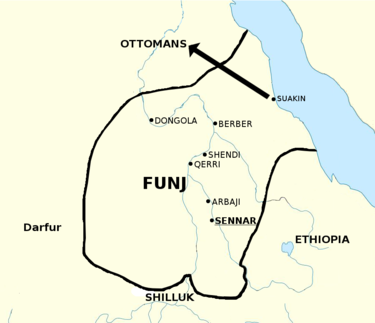
Downfall of Funj Sultanate: Invasion by Muhammad Ali alters regional power dynamics.
South Sudan
Political
Global Trade
4 min read
Updated By: History Editorial Network (HEN)
Published:
Updated:
The Funj Sultanate, located in what is modern-day Sudan, faced its downfall due to an invasion orchestrated by Egypt's ruler, Muhammad Ali, who served under the Ottoman Empire. The sultanate had been a prominent power in the region, characterized by its stability and control over trade routes. However, mounting pressures from both internal strife and external forces weakened its hold.
Muhammad Ali sought to expand his territories by leveraging Egypt's improved military capabilities, developed through modernization efforts. He dispatched a well-equipped expeditionary force, exploiting the sultanate's vulnerabilities. Upon invasion, the Funj Sultanate found itself incapable of repelling the advanced military tactics and weaponry of the Egyptian forces.
The fall of the Funj Sultanate led to significant shifts in the region's power dynamics. Egypt's control over the territory allowed them access to strategic trade routes and resources, furthering Muhammad Ali’s ambitions of regional dominance. This invasion didn't just represent a political shift but also marked changes in cultural and economic structures within the region. Traditional governance was supplanted by Ottoman administrative systems, influencing local societal structures.
This period also ignited a series of subsequent military campaigns by Egypt into deeper parts of the Sudanese territories, expanding their influence. The impact on the local populations was profound, as they adapted to new political realities and shifts in their trade and social practices.
#MoofLife #HistoricalShift #SudanHistory #OttomanEmpire #MilitaryCampaigns #TradeRoutes #PoliticalChange
Primary Reference
Funj Sultanate - Wikipedia

Explore the Life Moments of
 AI Twin