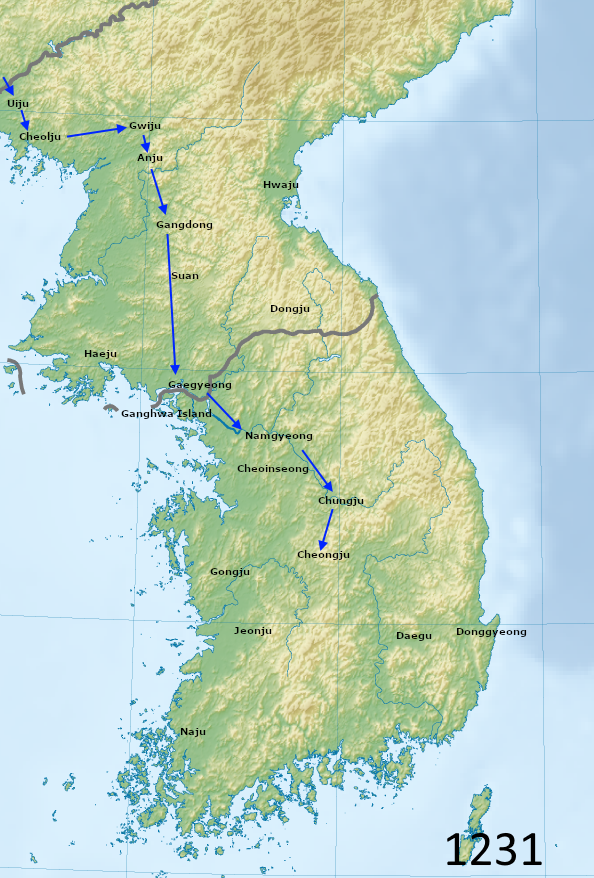
Mongol Invasion of Korea: Beginning of Conflict
South Korea

Political
Expansion
Conquest
4 min read
Updated By: History Editorial Network (HEN)
Published:
The Mongol invasion of Korea initiated when the Mongol Empire, under the rule of Genghis Khan, aimed to expand its territory. The invasion's roots lay in Goryeo's refusal to acknowledge Mongol authority and establish tributary ties. This defiance led the Mongols to launch military campaigns against Goryeo.
The invasion's impact was profound, resulting in significant losses for the Korean population. The Mongol forces displayed their military might through advanced warfare tactics, overwhelming the Korean defenses. Goryeo's capital, Gaesong, faced destruction, and many regions succumbed to Mongol control. The Korean people endured hardships under the Mongol rule, facing forced labor and heavy taxation.
Goryeo's King Gojong eventually surrendered, leading to the establishment of the Mongol-controlled Goryeo regime, known as the Mongol invasions of Korea. Despite the initial resistance, Goryeo's submission opened the doors for cultural exchanges and trade routes between Korea and the Mongol Empire.
The event marked a significant turning point in Korean history, shaping political dynamics and cultural interactions in East Asia. It highlighted the military prowess of the Mongol Empire and its ambitions for expansion. The invasion's aftermath saw a blend of Korean and Mongol traditions, influencing Korean society's evolution.
The Mongol invasion of Korea underscored the complexities of power struggles and territorial conquests in medieval East Asia. It remains a pivotal chapter in South Korea's history, illustrating the challenges and transformations brought about by foreign invasions.
#MongolInvasion #KoreanHistory #EastAsianDynamics #GoryeoResistance

Explore the Life Moments of
 AI Twin