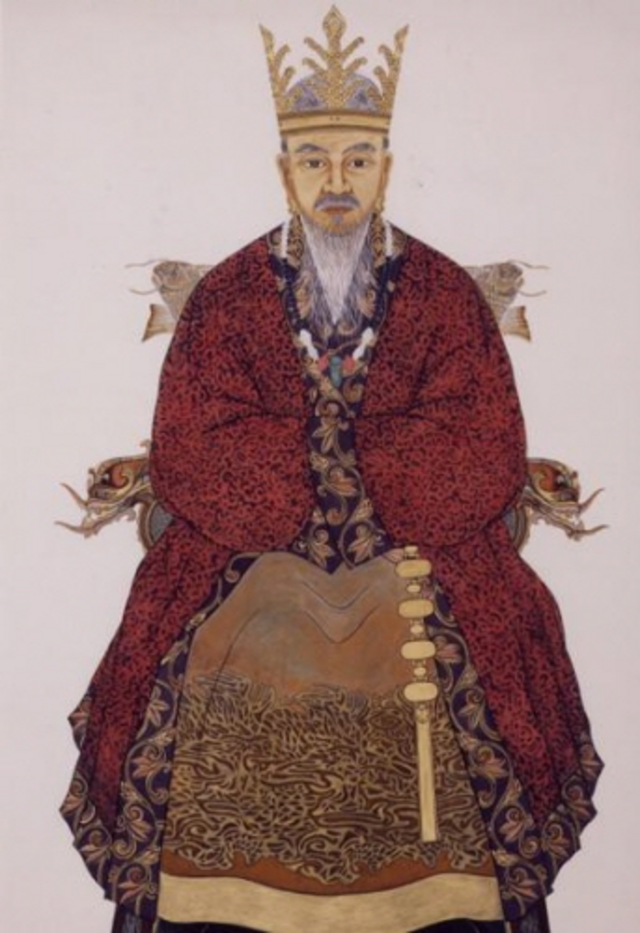
founding of Gaya by Suro
South Korea

Political
Sustainability
Founding
6 min read
Updated By: History Editorial Network (HEN)
Published:
The founding of Gaya by Suro, also known as Kim Suro or King Suro, is a significant event in Korean history, deeply rooted in the ancient legend and the establishment of one of the earliest kingdoms on the Korean Peninsula. According to historical and semi-mythological accounts, Gaya was founded in the first century CE by Suro, who is celebrated as the progenitor of the Gaya confederacy.
The Legend of King Suro
The foundation of Gaya is primarily narrated in the "Samguk Yusa" (Memorabilia of the Three Kingdoms), a 13th-century collection of legends, folktales, and historical accounts. According to the legend, King Suro was one of the six eggs sent from heaven, landing in a golden box on the banks of the Nakdong River. The eggs were discovered by local villagers, and from one of these eggs emerged a fully grown man who declared himself Suro, destined to be the ruler. This miraculous birth story emphasizes the divine right of Suro to establish and govern the new kingdom.
Establishing the Kingdom of Gaya
Upon his emergence, Suro quickly organized the local tribes and established a central authority. He chose Gimhae, a region in modern-day South Korea, as the capital of his kingdom. Gaya's strategic location near the Nakdong River and along the southeastern coast facilitated trade and communication, which were crucial for the kingdom's prosperity.
Suro's leadership skills and divine origin helped him unify the fragmented tribes under a single confederation. The Gaya confederacy, also known as the Garak Kingdom, became known for its advanced ironworking technology. The iron goods produced by Gaya were highly valued and widely traded with neighboring regions, including the Japanese archipelago, which significantly contributed to Gaya's economic strength.
The Union of Gaya and Heo Hwang-ok
An important aspect of Suro's reign is his marriage to Heo Hwang-ok, a princess from the distant land of Ayodhya in India. According to the legend, Heo Hwang-ok traveled across the sea to marry Suro after receiving divine instructions in a dream. Their union symbolizes the cultural and trade exchanges between the Korean Peninsula and distant lands, highlighting Gaya's role as a center of international trade and cultural exchange. This story also reflects the historical connections and migrations across Asia, contributing to the rich tapestry of Korean history.
#MomentsOfLife #MoofLife_Moment #MoofLife #KingSuro #GayaKingdom #HeoHwangok #KoreanHistory #AncientKorea #CulturalExchange #IronAgeKorea

Explore the Life Moments of
 AI Twin