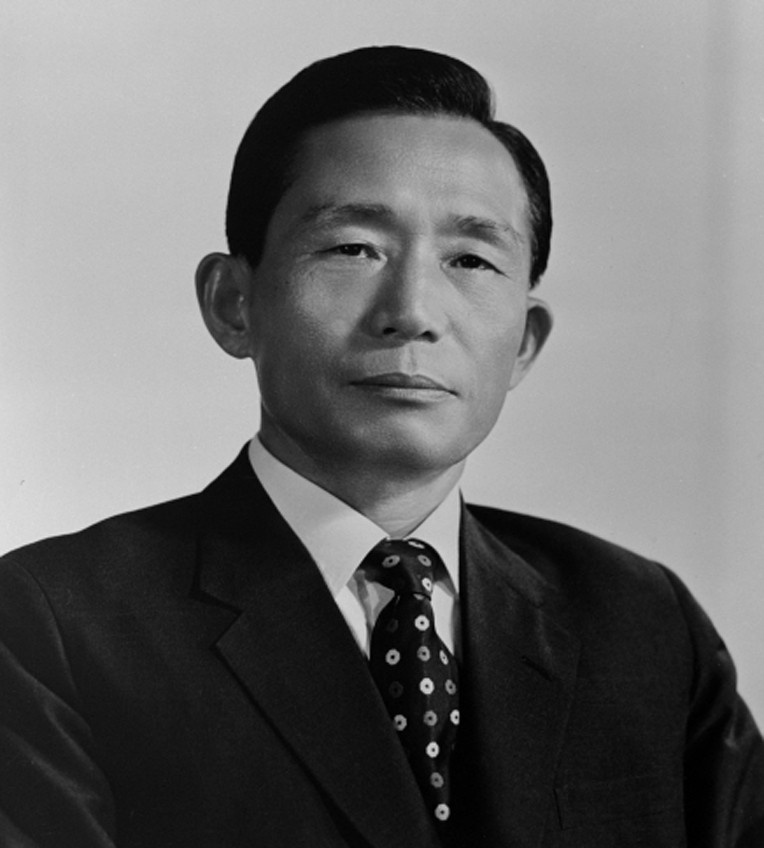
Assassination of Park Chung Hee
South Korea

Political
Assassination
9 min read
Updated By: History Editorial Network (HEN)
Published:
The assassination of Park Chung-hee on October 26, 1979, marked a dramatic turning point in South Korea’s history, ending an 18-year authoritarian rule and setting the stage for a turbulent period of political transition. Park, who had been the President of South Korea since 1961, was a highly controversial figure, credited with transforming South Korea’s economy while criticized for his repressive regime.
Background
Park Chung-hee came to power through a military coup in May 1961, overthrowing the Second Republic of South Korea. His regime was characterized by rapid industrialization and economic growth, often referred to as the "Miracle on the Han River." However, his rule was also marked by authoritarian practices, including the suppression of political opposition, censorship, and the use of the Korean Central Intelligence Agency (KCIA) to maintain control.
By the late 1970s, dissatisfaction with Park's regime had grown significantly. His declaration of emergency martial law in 1972, which led to the Yushin Constitution, effectively granted him dictatorial powers and extended his presidency indefinitely. This move, along with ongoing political repression and economic challenges, fueled widespread public discontent.
The Assassination
The events leading to Park’s assassination unfolded on the night of October 26, 1979, during a dinner party at the Blue House (the South Korean presidential residence) in Seoul. The gathering included several high-ranking officials, among them Kim Jae-gyu, the director of the KCIA, and Cha Ji-chul, Park’s chief bodyguard and a powerful figure within his administration.
Kim Jae-gyu, who had become increasingly disillusioned with Park’s repressive policies and Cha Ji-chul's growing influence, decided to act. During the dinner, an argument reportedly broke out between Kim and Cha. Seizing the moment, Kim drew a pistol and shot Cha, fatally wounding him. He then turned the gun on Park Chung-hee, shooting him in the head and chest, resulting in Park's immediate death. Kim Jae-gyu also killed other security personnel present at the scene to secure his escape.
Immediate Aftermath
Following the assassination, Kim Jae-gyu attempted to justify his actions as a move to save the nation from Park’s increasingly tyrannical rule. He believed that eliminating Park would pave the way for democratic reforms. However, his actions led to immediate chaos and uncertainty. Kim was quickly arrested, tried, and executed in May 1980.
In the short term, Park’s assassination plunged South Korea into political turmoil. Prime Minister Choi Kyu-hah assumed the presidency but struggled to maintain control amidst the power vacuum and growing demands for democracy. The immediate period following Park’s death saw intense political maneuvering among military and political elites.
Long-term Impact
The assassination of Park Chung-hee had profound and lasting impacts on South Korea. The power vacuum created by his death eventually led to the coup d'état on December 12, 1979, led by Major General Chun Doo-hwan, which further complicated the nation's path to democracy. Chun’s subsequent authoritarian rule faced significant opposition, culminating in the Gwangju Uprising of May 1980, where hundreds of pro-democracy demonstrators were killed by government forces.
Despite the repression, the momentum for democratization could not be halted. The public's desire for democracy, inspired partly by the abrupt end to Park’s long rule, gained strength throughout the 1980s. The June Democracy Movement of 1987 eventually forced Chun’s regime to concede to demands for democratic reforms, leading to the establishment of the Sixth Republic and the first democratic presidential elections.
Park Chung-hee's legacy remains complex and contested in South Korea. He is remembered both as a pivotal figure in South Korea's economic development and as a symbol of authoritarianism. His assassination, while initially plunging the nation into chaos, inadvertently set the stage for the eventual democratization of South Korea.
#MomentsOfLife #MoofLife_Moment #MoofLife #ParkChungHee #SouthKoreanHistory #Assassination #Democratization #PoliticalTransition #KCIA #YushinConstitution
Explore the Life Moments of
 AI Twin