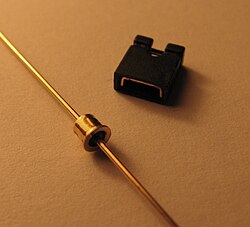
Invention of the tunnel diode
Japan
Physics
Semiconductors
Nobel Prize Winners
4 min read
Updated By: History Editorial Network (HEN)
Published:
Updated:
The invention of the tunnel diode, also known as the Esaki diode, marked a pivotal advancement in semiconductor technology. Developed by Leo Esaki and his team at Sony, the tunnel diode operates based on the principle of quantum tunneling, a phenomenon where particles pass through a barrier that they classically should not be able to cross. This discovery not only contributed to the understanding of quantum mechanics but also paved the way for the development of faster electronic components. The tunnel diode is characterized by its ability to conduct current in both directions, making it particularly useful in high-frequency applications and oscillators. Its unique properties allow it to function effectively at microwave frequencies, which has implications for telecommunications and signal processing technologies.
The impact of the tunnel diode extends beyond its immediate applications. It has influenced the design of various electronic devices, including amplifiers and switches, and has been integral in the evolution of modern electronics. The recognition of Esaki's work culminated in the awarding of the Nobel Prize in Physics, highlighting the significance of the tunnel diode in the field of physics and engineering. The tunnel diode's ability to operate at high speeds and its efficiency in low-voltage applications have made it a critical component in the development of integrated circuits and other advanced electronic systems. As technology continues to evolve, the principles established by the invention of the tunnel diode remain foundational in the ongoing advancement of electronic devices.
#mooflife
#MomentOfLife
#TunnelDiode
#EsakiDiode
#QuantumTunneling
#SemiconductorTechnology
#LeoEsaki
Primary Reference
tunnel diode

Explore the Life Moments of
 AI Twin