The Decline of Great Moravia
Slovakia
Political
CulturalLegacy
5 min read
Updated By: History Editorial Network (HEN)
Published:
Great Moravia, a prominent Slavic state in Central Europe, faced a pivotal moment when it succumbed to external pressures from invading forces. Background events leading up to this moment involved escalating tensions and conflicts with neighboring powers, notably the Hungarians. Great Moravia had been a significant entity, emerging in the early medieval period as a powerful polity by uniting various Slavic tribes under its rule.
The state’s prominence was marked by notable achievements such as the Christianization of its people, largely attributed to the missionary work of Saints Cyril and Methodius. Their efforts laid the groundwork for the spread of literacy and the establishment of the Glagolitic script. Great Moravia's strategic location made it both a cultural and economic hub, facilitating trade routes and the exchange of ideas across Europe.
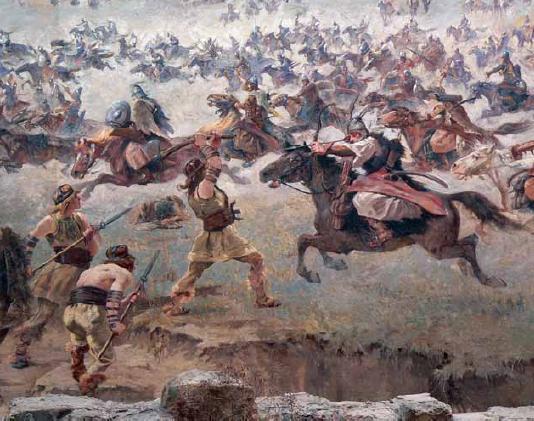
The decline of Great Moravia began as the internal cohesion of the state weakened. Power struggles, compounded by continuous raids from external forces, strained its resources and military capabilities. The decisive moment came when the Hungarians capitalized on these weaknesses, launching a series of invasions that overran the defenses of Great Moravia. The military confrontations were fierce, and the eventual defeat led to the disintegration of the state's political structure.
The fall had significant repercussions. The territories that once made up Great Moravia were absorbed into the expanding Hungarian realm, reshaping the political and cultural landscape of Central Europe. This transformation influenced the development of the region, particularly modern-day Slovakia, which was part of Great Moravia's heartland. The Hungarian dominance introduced new administrative systems and feudal structures, consolidating their influence over the former Moravian lands.
Archaeological findings and historical records provide insights into the societal changes during this period. Settlement patterns shifted, and there was a notable impact on the cultural continuity of the Slavic population. Despite the fall of Great Moravia, the legacy of its contributions to Slavic culture, especially through the work of Cyril and Methodius, continued to resonate in the Christian and linguistic traditions of the region.
#MoofLife #GreatMoravia #SlavicHistory #CulturalLegacy #HungarianInvasion #HistoricalTransition
Explore the Life Moments of
 AI Twin