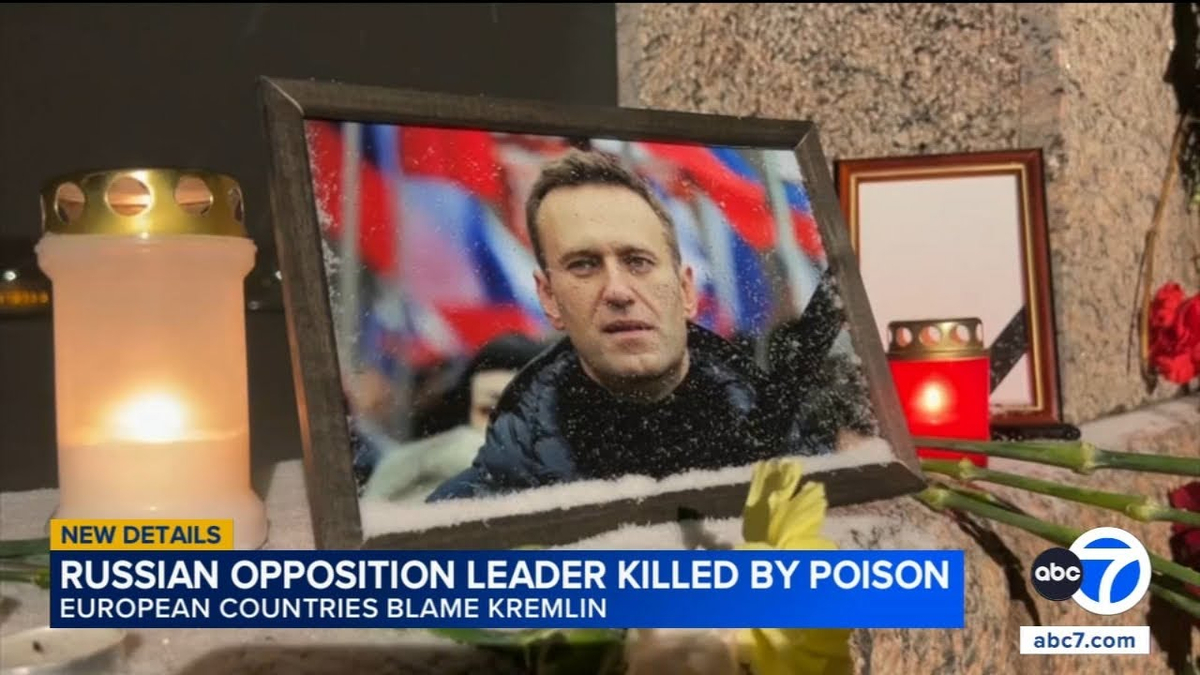
European Nations Allege Rare Toxin in Alexei Navalny’s Death in Joint Statement
London, Paris, Berlin, Stockholm, The Hague
Crime
Political
8 min read
Updated By: History Editorial Network (HEN)
Published:
Updated:
On 14/02/2026, ahead of the second anniversary of Alexei Navalny’s death, the foreign ministries of the United Kingdom, France, Germany, Sweden, and the Netherlands issued a joint statement alleging that independent laboratory analysis had identified a rare neurotoxin-epibatidine-as the cause of his death.
European Findings and Diplomatic Action:
The five European governments stated that biological samples, reportedly smuggled abroad prior to burial, were analyzed by independent laboratories. According to the joint statement, the tests “conclusively identified” epibatidine, a potent neurotoxin originally isolated from the skin of the poison dart frog Epipedobates anthonyi, a species native to Ecuador and Peru.
Epibatidine is known in scientific literature for its powerful effects on the nervous system. The joint statement argued that the toxin does not occur naturally in Russia and that synthesizing or procuring it requires specialized laboratory access and advanced technical capability. Based on these factors, the five nations asserted that only the Russian state had the “means, motive, and opportunity” to administer such a substance to a high-profile prisoner held in a remote Arctic penal colony.
The group formally reported the Russian Federation to the Organisation for the Prohibition of Chemical Weapons (OPCW), alleging breaches of the Chemical Weapons Convention and the Biological and Toxin Weapons Convention. The OPCW, headquartered in The Hague, oversees international compliance with chemical weapons prohibitions.
Medical descriptions from Navalny’s final moments, cited in the joint statement, referenced symptoms including heavy vomiting and convulsions. The European governments stated that these symptoms were consistent with epibatidine poisoning, though they did not publish full laboratory data in the public release.
Russian Government Response:
The Russian government rejected the findings. Kremlin spokesperson Dmitry Peskov stated that Moscow “strongly rejects” the accusations, describing them as “biased,” “unfounded,” and “not based on anything.”
Foreign Ministry spokeswoman Maria Zakharova characterized the report as a “Western propaganda hoax” and “necro-propaganda.” She argued that the timing-just days before the annual Munich Security Conference-was intended as a public relations campaign to distract from Western domestic issues, including ongoing investigations related to the Nord Stream pipeline.
Zakharova challenged the European governments to disclose detailed evidence, including substance formulas and complete test results, stating that Russia would only issue a comprehensive response once such data were made public. The Russian Embassy in London described the claims as a “ridiculous circus” and a “mockery of the dead,” questioning the plausibility of allegations involving a toxin associated with a South American frog species.
Scientific and International Context:
Although epibatidine is derived from a naturally occurring compound in poison dart frogs, it has been studied synthetically in laboratory settings. A 2013 Russian research publication documented experiments involving synthetic epibatidine as part of research into potential non-opioid analgesics, a point cited in the European statement to argue that Russian state-linked researchers had prior technical familiarity with the compound.
In Washington, U.S. Secretary of State Marco Rubio said the United States has “no reason to doubt” the European assessment but has not announced independent sanctions specifically tied to these new findings as of 14/02/2026.
The joint statement added a new diplomatic dimension to the case of Alexei Navalny, whose death in February 2024 while imprisoned in an Arctic colony had already drawn international condemnation and sanctions against Russian officials. Further action now depends on any investigation or proceedings undertaken by the OPCW and on whether additional forensic evidence is publicly released.
#AlexeiNavalny
#OPCW
#Epibatidine
#Russia
#EuropeanUnion
#ChemicalWeaponsConvention

Explore the Life Moments of
 AI Twin