Rosa Parks bus Protest Ignites Civil Rights Movement
Montgomery, Alabama, United States
7 min read
Updated By: History Editorial Network (HEN)
Published:
Updated:
On 01/12/1955, Rosa Parks was arrested in Montgomery, Alabama, after refusing to surrender her seat to a white passenger on a segregated city bus. Her act of defiance became the immediate catalyst for the Montgomery Bus Boycott, a 381-day mass protest that challenged segregation laws and helped launch the modern American civil rights movement.
At the time of her arrest, Parks was a 42-year-old seamstress and an experienced civil rights activist who served as secretary of the Montgomery branch of the National Association for the Advancement of Colored People (NAACP). Montgomery’s Jim Crow laws required Black passengers to sit in designated sections of buses and give up seats to white riders when instructed by drivers. Black residents regularly faced humiliation, abuse, and discriminatory treatment on public transportation.
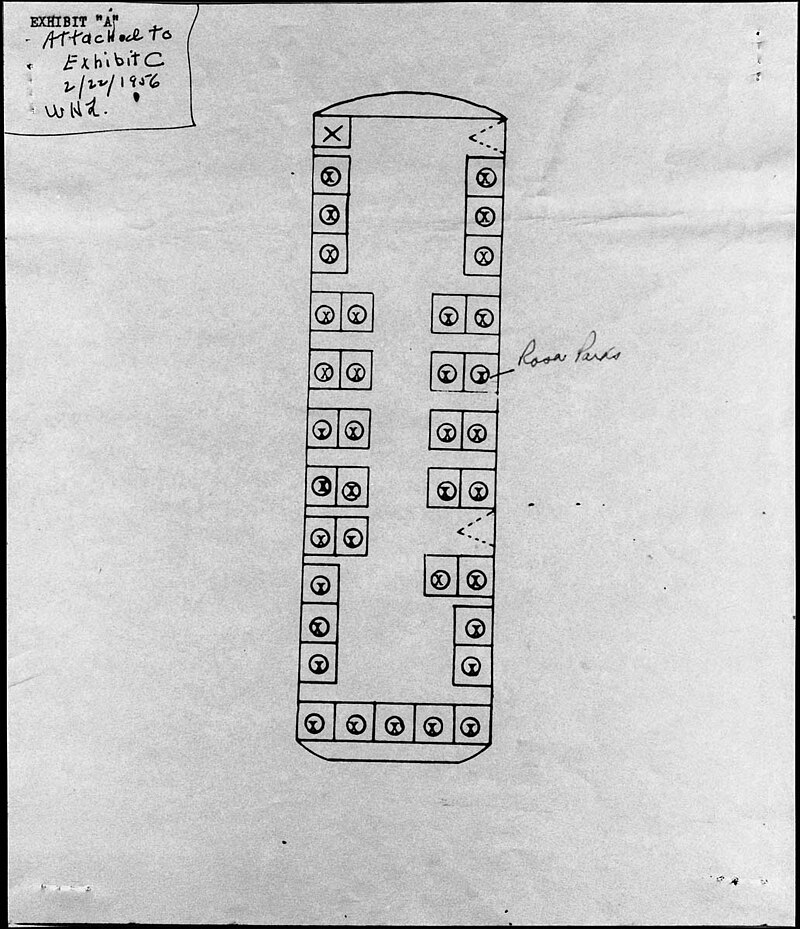
On the evening of 01/12/1955, bus driver James F. Blake ordered Rosa Parks and several other Black passengers to vacate their row to accommodate a white passenger. While others complied, Parks remained seated and was arrested by police for violating Montgomery’s segregation ordinance.
Local civil rights organizers, including Jo Ann Robinson of the Women’s Political Council and NAACP leader E.D. Nixon, responded quickly by organizing a citywide boycott of Montgomery’s buses. More than 35,000 leaflets were distributed throughout the Black community calling for residents to avoid public buses on 05/12/1955, the date of Parks’ trial.
The protest received overwhelming support from Montgomery’s African American population. Approximately 40,000 Black commuters participated by walking, carpooling, or arranging alternative transportation rather than using segregated buses. That evening, community leaders established the Montgomery Improvement Association (MIA) and selected Dr. Martin Luther King Jr., then a young pastor at Dexter Avenue Baptist Church, as president of the organization.
The boycott continued for 381 days despite arrests, violence, intimidation, and economic pressure. Participants maintained extensive carpool systems and community support networks throughout the campaign. During the protest, King’s home was bombed, and many activists received threats, but the movement remained committed to nonviolent resistance.
On 13/11/1956, the United States Supreme Court upheld a lower court ruling in Browder v. Gayle, declaring segregation on public buses unconstitutional. Montgomery officially integrated its buses on 20/12/1956, bringing the boycott to an end.
Rosa Parks’ arrest became one of the most recognized acts of civil disobedience in American history. The boycott demonstrated the power of organized nonviolent protest and helped establish strategies later used throughout the civil rights movement during the 1950s and 1960s.
Historical Significance :
The Montgomery Bus Boycott showed that sustained grassroots organizing and nonviolent protest could successfully challenge institutional segregation. Rosa Parks’ act of resistance helped inspire future campaigns for voting rights, school desegregation, and racial equality across the United States.
Primary Reference
Rosa Parks takes a stand by sitting down

Explore the Life Moments of
 AI Twin