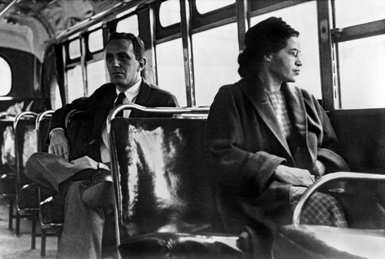
Plans for Montgomery Bus Boycott Announced
Montgomery, Alabama, United States
Civil Rights Movement
Historical Events
Social Justice
6 min read
Updated By: History Editorial Network (HEN)
Published:
Updated:
On 04/12/1955, civil rights organizers in Montgomery, Alabama, publicly announced plans for a citywide bus boycott following the arrest of Rosa Parks three days earlier. The effort, coordinated by local Black leaders and activists, called on African American residents to refuse bus travel on Monday, 05/12/1955, the day of Parks’ trial for violating the city’s segregation laws.
Rosa Parks had been arrested on 01/12/1955 after refusing to surrender her seat to a white passenger on a segregated Montgomery city bus. Her arrest quickly galvanized local activists who had long opposed discriminatory treatment on public transportation. Among the first organizers to act was Jo Ann Robinson, president of the Women’s Political Council (WPC), a group that had previously warned city officials about widespread frustration within Montgomery’s Black community over bus segregation and mistreatment.
Working overnight with colleagues at Alabama State College, Robinson helped produce and distribute more than 35,000 leaflets urging Black residents to stay off city buses on 05/12/1955. The flyers instructed people to avoid riding buses to work, school, downtown, or any other destination for one day in protest of Parks’ arrest and the city’s segregation policies.
E.D. Nixon, a longtime civil rights organizer and local NAACP leader, also played a central role in coordinating support for the boycott. Nixon worked with ministers, community leaders, and activists to organize a broader response that extended beyond a single-day protest. On Sunday, 04/12/1955, Black churches across Montgomery announced the boycott during services, helping spread the message rapidly throughout the city’s African American neighborhoods.
Local Black newspapers and community networks further amplified the campaign. By the morning of 05/12/1955, tens of thousands of Black residents participated in the boycott, choosing to walk, carpool, or arrange alternative transportation rather than ride segregated buses. The overwhelming response demonstrated the organizational strength of Montgomery’s Black community and encouraged leaders to continue the protest beyond the initial one-day action.
That evening, civil rights leaders formed the Montgomery Improvement Association (MIA) and selected Dr. Martin Luther King Jr. as its president. The boycott eventually lasted 381 days and concluded after the United States Supreme Court upheld a ruling declaring bus segregation unconstitutional in late 1956.
Historical Significance :
The public announcement of the boycott on 04/12/1955 marked the beginning of one of the most influential mass protests in American history. The rapid organization of the campaign demonstrated the importance of grassroots networks, churches, women’s leadership, and community coordination within the civil rights movement.
#mooflife
#MomentOfLife
#MontgomeryBusBoycott
#CivilRightsMovement
#RacialSegregation
#AfricanAmericanHistory
#NonviolentProtest
Primary Reference
Montgomery Bus Boycott

Explore the Life Moments of
 AI Twin