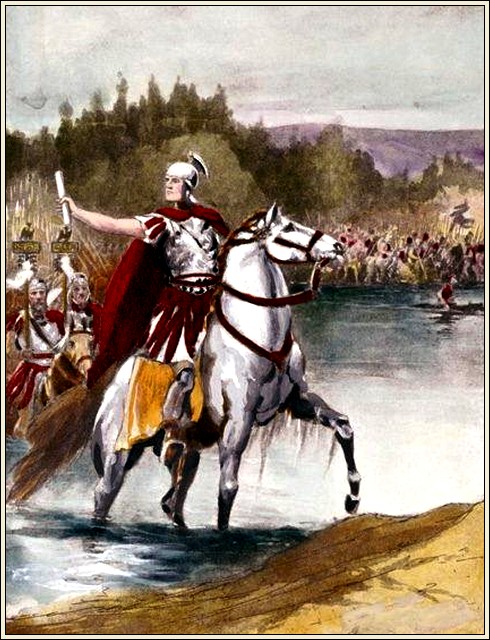
The crossing of the Rubicon River by Julius Caesar
Rome
Military
Roman Empire
4 min read
Updated By: History Editorial Network (HEN)
Published:
Updated:
The crossing of the Rubicon River by Julius Caesar with his veteran army marked a pivotal moment in Roman history. The Rubicon served as a legal boundary within Italy, and Roman law prohibited any general from bringing an army across it. By crossing the river, Caesar effectively declared war against the Roman Senate and his political rival, Pompey. This act of defiance was not merely a military maneuver; it was a calculated political statement that challenged the authority of the Senate and the existing power structure in Rome. Following the crossing, Caesar advanced rapidly down the Italian peninsula, which forced Pompey, along with the consuls and the Senate, to abandon Rome and retreat to Greece. This swift action allowed Caesar to enter Rome unopposed, consolidating his power and influence over the city.
The implications of Caesar's actions were profound. His decision to cross the Rubicon initiated a civil war that would ultimately reshape the Roman Republic. After entering Rome, Caesar turned his focus to Pompey's stronghold in Hispania but soon shifted his attention to confront Pompey directly in Greece. Although Pompey initially achieved victory against Caesar, he failed to capitalize on this success, leading to his decisive defeat at the Battle of Pharsalus. This battle marked a turning point in the civil war, resulting in Pompey's flight to Egypt, where he was later assassinated. The events following the crossing of the Rubicon not only led to the downfall of Pompey but also set the stage for the rise of Caesar as a central figure in Roman politics, ultimately leading to the end of the Roman Republic and the establishment of the Roman Empire.
#mooflife
#MomentOfLife
#JuliusCaesar
#RubiconRiver
#RomanCivilWar
#Pompey
#RomanHistory
Primary Reference
Crossing the Rubicon

Explore the Life Moments of
 AI Twin