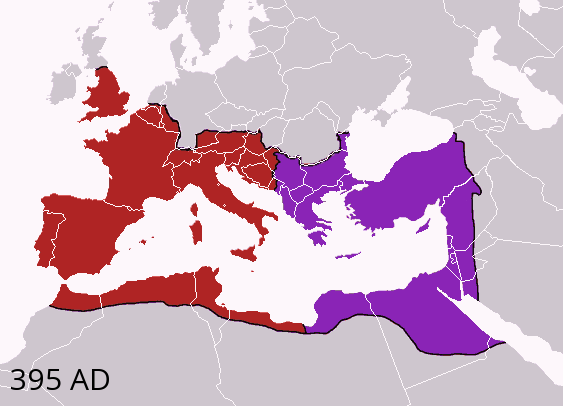
East–West Division of the Empire
Italy
Roman History
Byzantine Studies
Ancient Civilizations
6 min read
Updated By: History Editorial Network (HEN)
Published:
Updated:
The Roman Empire underwent its final and permanent division in 395 AD following the death of Emperor Theodosius I, the last ruler to govern both the Eastern and Western halves of the empire. Upon his death on 17/01/395, authority was divided between his two sons: Arcadius assumed control of the Eastern Roman Empire, ruling from Constantinople, while Honorius became emperor of the Western Roman Empire, governing from Milan and later Ravenna. This transition formalized a separation that would endure for the remainder of Roman history.
Although administrative divisions had been implemented earlier, particularly under Emperor Diocletian’s Tetrarchy established in 285 AD, those arrangements were designed to improve governance across vast territories rather than to create independent states. Subsequent reunifications under emperors such as Constantine I and Theodosius I himself reinforced the idea of a single Roman Empire. However, by the late 4th century, growing logistical, military, and economic challenges made centralized rule increasingly difficult to sustain.
The division of 395 AD reflected deeper structural differences between the two halves. The Eastern Empire, with its राजधानी in Constantinople, possessed greater urbanization, stronger economic networks, and more defensible frontiers. In contrast, the Western Empire faced persistent military pressures along the Rhine and Danube frontiers, declining urban centers, and reduced financial resources. These differences became more pronounced over time, particularly as the Western Empire struggled to respond effectively to invasions and internal instability during the 5th century.
The political separation also influenced cultural and administrative development. While Latin remained dominant in the West, Greek became the primary administrative language in the East. Legal, military, and religious institutions evolved along different trajectories, even though both halves continued to identify as part of the Roman world. The Eastern Roman Empire, later known as the Byzantine Empire, maintained continuity in governance and imperial authority long after the Western Empire ceased to function in 476 AD.
The division established in 395 AD was never reversed. Instead, it created two distinct centers of power whose differing capacities shaped their survival. The Western Roman Empire fragmented under the pressures of the 5th century, while the Eastern Empire continued as a major political entity for nearly a thousand years.
Why This Moment Matters:
The division of the Roman Empire in 395 AD established two separate imperial administrations that evolved independently, contributing to the survival of the Eastern Roman Empire and the eventual collapse of the Western half in 476 AD.
#RomanEmpire #AncientHistory #TheodosiusI #ByzantineEmpire #395AD #LateAntiquity
#mooflife
#MomentOfLife
#RomanEmpire
#ByzantineEmpire
#East-westDivision
#HistoricalImpact
#CulturalDevelopment
Primary Reference
Roman-Empire

Explore the Life Moments of
 AI Twin