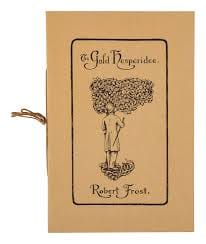
Robert Frost Publishes “The Gold Hesperidee”
United States
Literature
Book Reviews
Historical Analysis
4 min read
Updated By: History Editorial Network (HEN)
Published:
Updated:
On 28/07/1935, Robert Frost’s poem The Gold Hesperidee was published as a separate pamphlet in a limited edition. The poem later appeared in his 1936 collection A Further Range, which earned Frost his third Pulitzer Prize the following year. Issued as an individual publication, the 1935 pamphlet reflected Frost’s practice of releasing select poems independently before incorporating them into larger collections. The poem centers on a farmer named Square Matthew Hale, whose attention is devoted to cultivating a grafted apple tree of a rare fictional variety called the “Gold Hesperidee.” The narrative follows the seasonal cycle of the tree from flowering through fruiting, presented with detailed observations of orchard work.
The title draws from Greek mythology, specifically the Hesperides, nymphs who guarded a tree bearing golden apples in a garden visited by Heracles during one of his labors. Frost’s poem adapts this imagery into a New England agricultural setting, blending mythological reference with realistic rural detail. The farmer’s attachment to the tree becomes central to the poem’s development, particularly when the anticipated fruit is discovered missing. Through this narrative, Frost explores themes involving attachment, expectation, and disappointment, while maintaining a descriptive approach grounded in agricultural processes and seasonal change.
When included in A Further Range in 1936, The Gold Hesperidee formed part of a broader expansion in Frost’s mid career work, where traditional rural imagery intersected with allegorical and philosophical concerns. The 1935 pamphlet therefore represents an intermediate publication that connected Frost’s established pastoral style with the wider thematic scope of his later collection.
#RobertFrost
#TheGoldHesperidee
#AmericanPoetry
#AFurtherRange
#LiteraryHistory
Primary Reference
Robert Frost

Explore the Life Moments of
 AI Twin