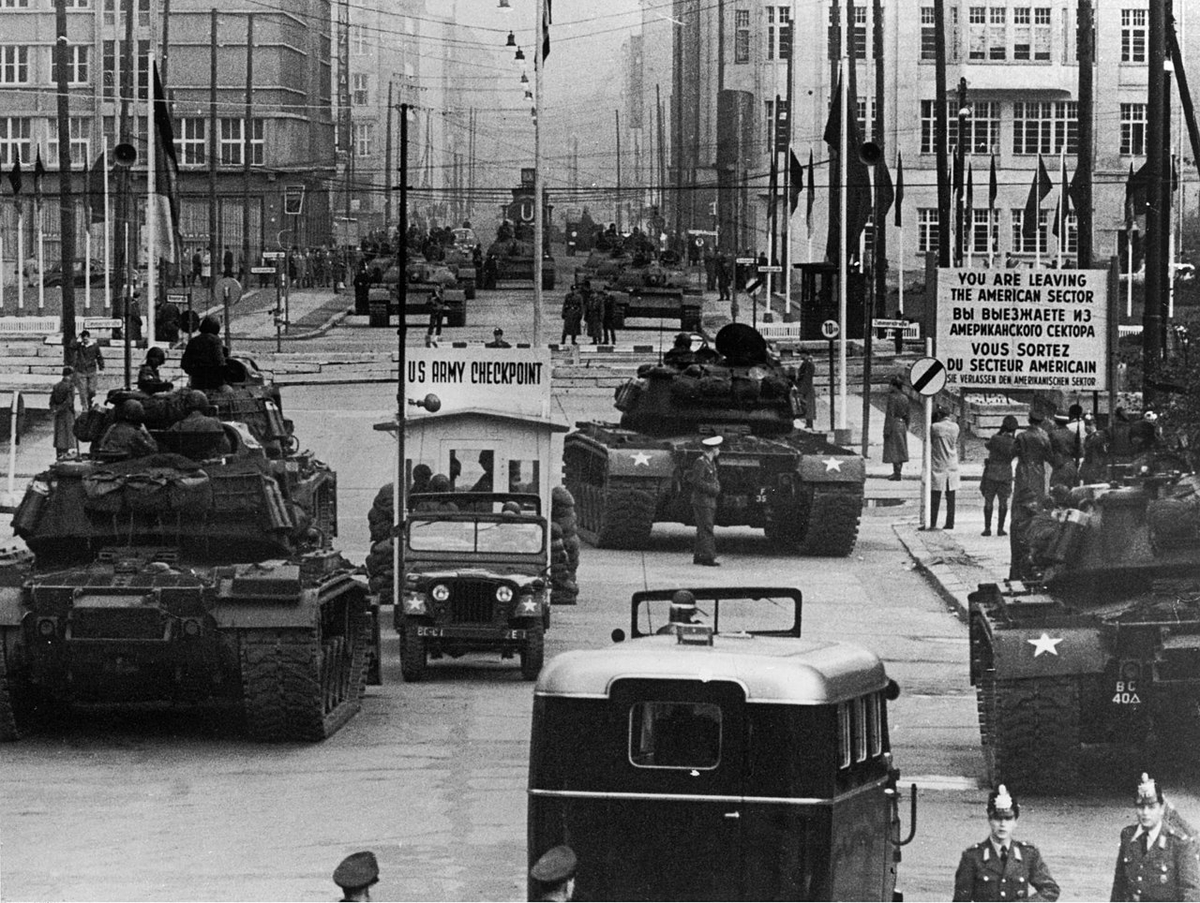
Robert F. Kennedy Resolves Checkpoint Charlie Standoff During Cold War
United States of America
Political
Global Trade
4 min read
Updated By: History Editorial Network (HEN)
Published:
During the Cold War, Robert F. Kennedy played an instrumental role in resolving the Checkpoint Charlie tank standoff in Berlin. The incident occurred during a period of heightened tensions between the United States and the Soviet Union. Berlin was a focal point of the Cold War, divided into East and West, with the Berlin Wall symbolizing the ideological split.
The standoff was triggered when American diplomats attempted to cross from West Berlin into East Berlin without Soviet inspection. In response, Soviet and American tanks faced off at Checkpoint Charlie, one of the few crossing points between the sectors. The possibility of armed conflict loomed large, with both superpowers prepared for escalation, risking a wider military confrontation.
Robert F. Kennedy, serving as the Attorney General of the United States, engaged in behind-the-scenes communications with Soviet representatives. His direct and cautious approach helped de-escalate the situation. Through a series of negotiations, a mutual withdrawal of the tanks was arranged, defusing the immediate threat without the loss of life or further escalation.
The resolution of the Checkpoint Charlie tank standoff had substantial implications. It highlighted the critical role of diplomacy and direct communication in managing Cold War tensions. The event underscored the precarious nature of the Berlin divide and the broader East-West relations during this period. Additionally, it demonstrated Robert F. Kennedy's strategic influence and ability to manage international crises.
#ColdWarDiplomacy #CheckpointCharlie #BerlinCrisis #RobertFKennedy #USSRRelations #MoofLife
Primary Reference
The standoff at Checkpoint Charlie – History of Sorts
Explore the Life Moments of
 AI Twin