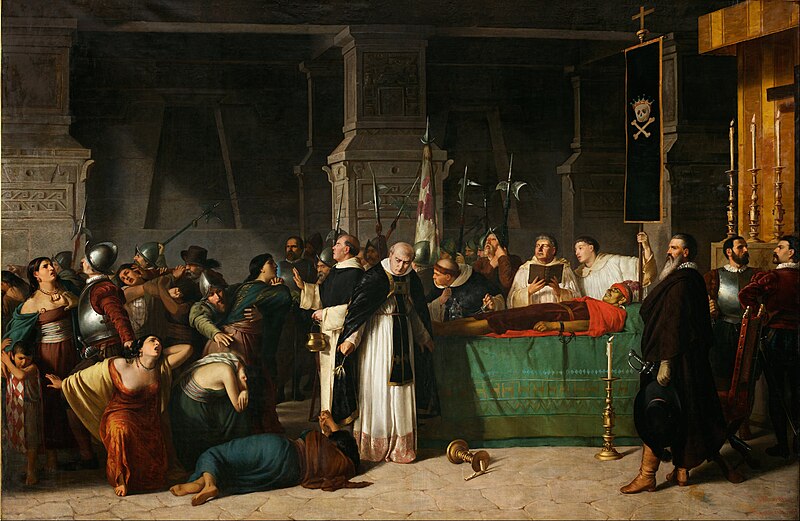
Execution of the last Sapa Inca Atahualpa
Peru
Colonial Studies
Indigenous Peoples
4 min read
Updated By: History Editorial Network (HEN)
Published:
Updated:
Atahualpa, the last Sapa Inca, was executed by the Spaniards on 29 August 1533. His death marked a significant point in the Spanish conquest of the Inca Empire. Following his execution, the Spanish continued their campaign to conquer and colonize the region, leading to the establishment of the Viceroyalty of Peru with its capital at Lima. The conquest had profound effects on the Indigenous population, including a dramatic collapse due to epidemic diseases introduced by the Spanish, exploitation, and socio-economic changes. The Spanish reorganized the country with gold and silver mining as its main economic activity, using Amerindian forced labor as the primary workforce. The discovery of great silver and gold lodes at Potosí and Huancavelica made the viceroyalty an important provider of mineral resources, fueling a complex trade network extending to Europe and the Philippines. The spread of Christianity was also a significant aspect of the conquest, with most people being forcefully converted to Catholicism. The church played a crucial role in the acculturation of the Natives, integrating religious native rituals with Christian celebrations. By the 18th century, declining silver production and economic diversification led to the enactment of the Bourbon Reforms, which increased taxes and partitioned the Viceroyalty. These changes provoked rebellions, including Túpac Amaru II's rebellion, which were suppressed. The Spanish and their creole successors monopolized control over the land, seizing many of the best lands abandoned by the massive native depopulation. The viceroyalty eventually dissolved in the early 19th century due to national independence movements, leading to the formation of modern-day countries in South America.

Explore the Life Moments of
 AI Twin