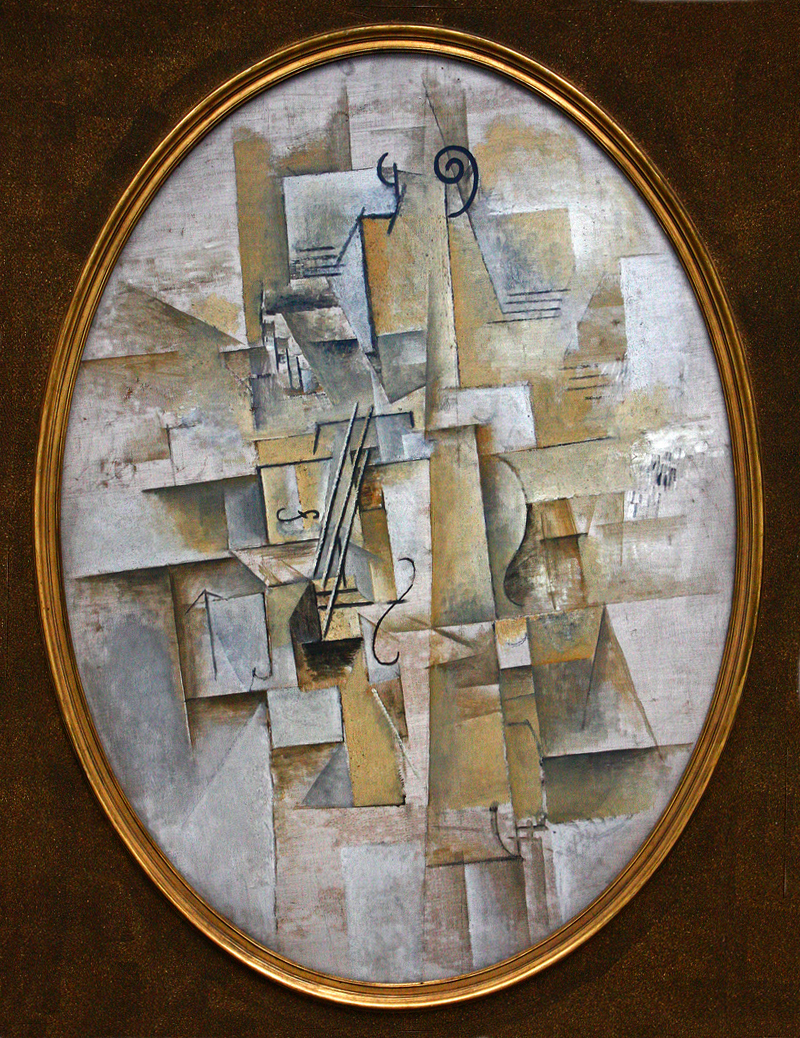
Picasso's "Painted Violon (Violin)": Bold Cubist masterpiece at Kröller-Müller Museum.
Spain
Art
Culture
4 min read
Updated By: History Editorial Network (HEN)
Published:
In the early 20th century, Pablo Picasso created the artwork titled "Painted Violon (Violin)," which is now housed in the Kröller-Müller Museum in the Netherlands. Picasso's painting captures a violin through the lens of Cubism, emphasizing fragmented forms and multiple perspectives. This painting is part of his Synthetic Cubism phase, where Picasso moved from the angular abstractions of Analytical Cubism to incorporating simpler shapes and more vibrant colors.
The painting reflects the broader European avant-garde movement, where artists sought to break away from traditional techniques and forms. By focusing on the violin, an object often associated with classical music and traditional art, Picasso juxtaposed these cultural symbols with the revolutionary approach of Cubism. This particular piece also highlights Picasso's interest in everyday objects and his ability to transform them into complex, multi-dimensional experiences.
The impact of "Painted Violon (Violin)" within the art community was notable. It epitomized the shift from realistic portrayals to abstract representations, influencing not only visual arts but also poetry and literature. The Kröller-Müller Museum, which acquired the painting, has since become a crucial repository for modern art, offering visitors insights into pivotal moments of artistic innovation.
Statistics relevant to this period show a burgeoning interest in modern art movements, with museums such as the Kröller-Müller amassing significant collections. Art sales of this kind of revolutionary work were modest initially but have surged over the decades, reflecting the growing appreciation of Picasso’s contributions to art.
#Cubism #ModernArt #Picasso #KröllerMüllerMuseum #ArtEvolution #MoofLife
Primary Reference
Kröller-Müller Museum - Wikipedia
Explore the Life Moments of
 AI Twin