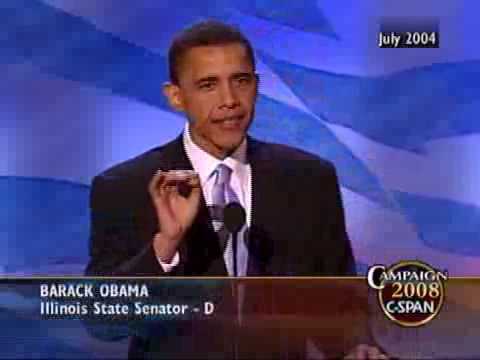
Turning Point - Keynote address at the Democratic National Convention

Political
10 min read
Updated By: History Editorial Network (HEN)
Published:
On July 27, 2004, Barack Obama, then a little-known state senator from Illinois, delivered the keynote address at the Democratic National Convention (DNC) in Boston, Massachusetts. This speech, which electrified the nation and catapulted Obama into the national spotlight, is widely regarded as one of the most memorable political addresses in recent American history. It was the moment that introduced Obama to a broader audience and set the stage for his meteoric rise in American politics.
The Context of the 2004 DNC
The 2004 Democratic National Convention was held during a highly contentious election year. The Democratic Party had united around Senator John Kerry of Massachusetts as its nominee to challenge incumbent President George W. Bush. The convention aimed to rally the party and the nation around Kerry’s candidacy, offering a compelling alternative to four more years of Bush’s administration, which had been marked by the controversial Iraq War and economic uncertainty.
As the keynote speaker, Obama was given the responsibility of delivering a speech that would not only inspire the delegates in attendance but also resonate with a national audience. His selection as the keynote speaker was a bold choice; at the time, Obama was not widely known outside of Illinois, where he was serving as a state senator and running for the U.S. Senate. However, those who had observed his rise in Illinois politics recognized his potential as a powerful and charismatic orator.
The Speech: A Call for Unity and Hope
Obama's speech, titled "The Audacity of Hope," was a masterful blend of personal narrative, political philosophy, and a call for national unity. He began by introducing himself and his background, highlighting his biracial heritage and the immigrant roots of his family. Obama spoke about his father’s journey from Kenya to the United States in pursuit of education and opportunity, and his mother’s Midwestern upbringing, which instilled in him a belief in hard work and the American Dream.
One of the most powerful aspects of the speech was Obama’s ability to connect his personal story to the broader American experience. He framed his life as a testament to the possibilities that America offers to all its citizens, regardless of their background. This message of inclusivity and shared destiny was central to Obama’s political philosophy and would become a recurring theme in his future campaigns.
Obama also addressed the deep divisions within American society, particularly the growing polarization of its politics. He called for an end to the "politics of division," urging Americans to come together around common values and shared goals. He famously declared, "There is not a liberal America and a conservative America—there is the United States of America. There is not a Black America and a White America and Latino America and Asian America—there's the United States of America."
This message of unity struck a chord with the audience, both in the convention hall and across the country. Obama’s eloquence, optimism, and appeal to the better angels of American democracy resonated deeply, offering a sharp contrast to the negative and often divisive rhetoric that had come to dominate political discourse.
The Impact and Aftermath
The impact of Obama’s keynote address was immediate and profound. The speech was widely praised by political commentators and the media, with many noting that a new star had emerged on the national stage. Obama's ability to articulate a vision of hope and unity, combined with his compelling personal story, made him a standout figure at the convention.
The speech had a lasting effect on Obama’s career. Just a few months later, in November 2004, he was elected to the U.S. Senate in a landslide victory, becoming only the third African American to serve in the Senate since Reconstruction. The momentum from his DNC speech carried him through his Senate campaign and laid the foundation for his 2008 presidential run.
In retrospect, the 2004 DNC speech is often seen as the moment that Obama’s political trajectory changed course. It was the speech that introduced him to the nation and established him as a voice for a new generation of American leaders. His message of hope and unity would continue to define his political career, culminating in his historic election as the 44th President of the United States in 2008.
Legacy of the Speech
The July 27, 2004, keynote address at the Democratic National Convention remains one of the defining moments of Barack Obama’s political life. It encapsulated the themes that would guide his public service—unity, hope, and the belief in a better, more inclusive America. For many, it was the first glimpse of the leader who would go on to change the course of American history.
#MomentsOfLife #MoofLife_Moment #MoofLife #Obama2004 #DNC2004 #AmericanHistory #YesWeCan #PoliticalHistory
Primary Reference
Keynote Address at the 2004 Democratic National Convention | The ...
Explore the Life Moments of
 AI Twin