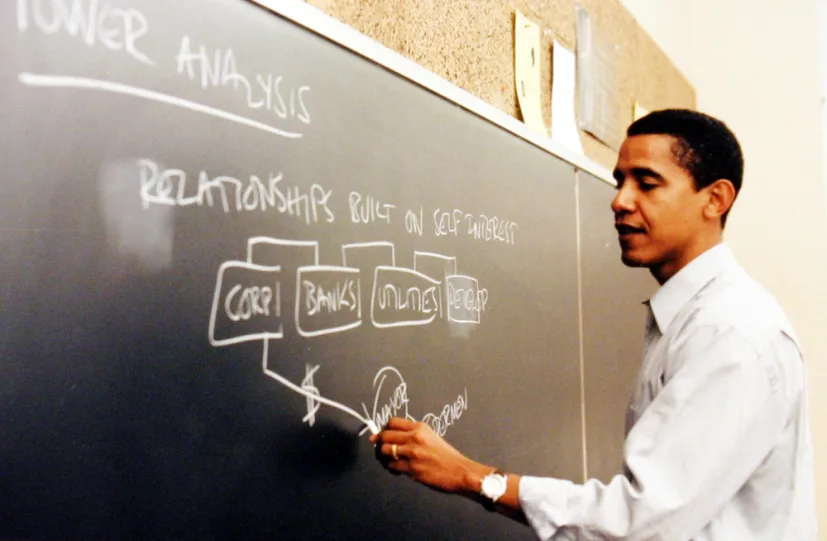
Began teaching constitutional law at the University of Chicago Law School
Education
Teaching
10 min read
Updated By: History Editorial Network (HEN)
Published:
In 1992, shortly after completing his studies at Harvard Law School, Barack Obama began teaching constitutional law at the University of Chicago Law School. This position marked the start of a significant chapter in Obama's life, blending his deep interest in the law with his passion for public service and education. His tenure as a lecturer and later as a senior lecturer at the University of Chicago lasted until 2004, during which time he established himself as a respected academic and a thoughtful legal mind.
The Path to Teaching
After graduating from Harvard Law School in 1991, where he gained national attention as the first African American president of the Harvard Law Review, Obama returned to Chicago with a strong desire to work in public service. He turned down several lucrative job offers from prestigious law firms, choosing instead to work as a civil rights attorney with the Chicago law firm Miner, Barnhill & Galland. Concurrently, Obama sought to engage more directly with the community and influence the next generation of lawyers, which led him to accept a teaching position at the University of Chicago Law School.
Obama’s decision to teach constitutional law was a natural extension of his interests and academic background. Constitutional law, with its focus on the fundamental principles of justice, equality, and the balance of powers, aligned with Obama’s commitment to civil rights and social justice. His role as a teacher allowed him to explore these ideas in depth while also imparting his knowledge to students who would go on to become influential lawyers, judges, and policymakers.
Teaching Style and Influence
Obama began his teaching career at the University of Chicago as a lecturer, a title that later changed to senior lecturer in recognition of his contributions to the law school. Although he was never a full-time professor, his role as a senior lecturer was akin to that of an adjunct professor, and he taught courses on constitutional law and civil rights. His courses were highly popular among students, who were drawn to his engaging teaching style and his ability to connect complex legal theories to real-world issues.
Obama was known for his Socratic method of teaching, encouraging students to think critically and engage in thoughtful debate. He often challenged his students to consider the broader implications of legal decisions and to understand the historical and social contexts in which laws were made. His approach to teaching was deeply influenced by his belief in the law as a tool for achieving social change, and he often drew on his own experiences as a community organizer and civil rights attorney to illustrate the practical applications of constitutional principles.
Many of Obama’s students have spoken about the profound impact he had on their education and careers. His ability to distill complex legal concepts into accessible and meaningful discussions made him a beloved figure at the law school. Moreover, his reputation as a fair and open-minded teacher who respected differing viewpoints helped to foster a classroom environment where robust and respectful debate could thrive.
Balancing Academia and Public Service
During his time at the University of Chicago Law School, Obama also pursued a parallel career in public service. In 1996, he was elected to the Illinois State Senate, representing the 13th District, which included parts of Chicago’s South Side. Despite the demands of his political career, Obama continued to teach at the law school, balancing his legislative responsibilities with his commitment to education.
This dual role as a legislator and educator allowed Obama to bring a unique perspective to his teaching. He often incorporated his experiences in the state senate into his lectures, providing students with firsthand insights into the intersection of law, politics, and public policy. This combination of academic rigor and practical experience made Obama’s courses particularly valuable for students interested in pursuing careers in public service or law.
Legacy and Impact
Obama’s tenure at the University of Chicago Law School significantly shaped his understanding of the law and its role in American society. It provided him with a platform to refine his ideas about constitutional interpretation, civil rights, and social justice—ideas that would later influence his policies as President of the United States.
The relationships and connections Obama built during his time at the law school also played a crucial role in his political career. Many of his former colleagues and students became key supporters and advisors during his campaigns for the U.S. Senate and the presidency. Furthermore, his work at the law school bolstered his credentials as a constitutional scholar, lending intellectual weight to his legislative and executive actions.
Obama’s years at the University of Chicago Law School were a formative period in his life, allowing him to merge his legal exper
Primary Reference
Chicago: Where it Began | The Obama Foundation
Explore the Life Moments of
 AI Twin