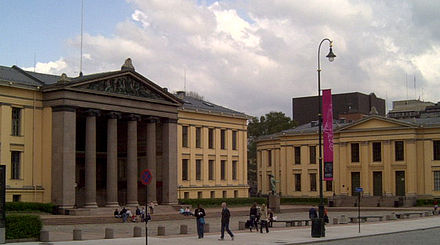
Establishment of the University of Oslo by King Christian IV of Denmark in Christiania.
Norway

Education
Cultural Development
9 min read
Updated By: History Editorial Network (HEN)
Published:
On September 2, 1811, the University of Oslo was established by King Frederick VI of Denmark in the city of Christiania, now known as Oslo. This institution, originally named the Royal Frederick University (Det Kongelige Frederiks Universitet), was founded during a period of significant political and cultural transformation in Norway, and it has since played a pivotal role in the development of Norwegian education, culture, and national identity.
Background: Norway under Danish Rule
At the time of the university's founding, Norway was in a union with Denmark, a situation that had been in place since the late 14th century. This period was marked by Danish dominance in political and cultural affairs, with Norway often being treated as a lesser partner in the union. Higher education in Norway was underdeveloped, with those seeking advanced education typically having to travel to the University of Copenhagen in Denmark.
The early 19th century was a time of rising Norwegian nationalism and a growing desire for cultural and educational independence. The Napoleonic Wars, which strained the union between Denmark and Norway, and the increasing influence of the Enlightenment ideals contributed to a stronger Norwegian identity and the push for national institutions, including a university.
The Founding of the University
The idea of establishing a university in Norway gained significant momentum in the late 18th and early 19th centuries. Key figures in Norwegian society, including clergymen, intellectuals, and nationalists, advocated for the creation of a university that could serve as a center for learning and cultural development within Norway.
King Frederick VI of Denmark, responding to these pressures and recognizing the importance of a university in promoting loyalty and unity within the kingdom, approved the establishment of the Royal Frederick University on September 2, 1811. The decision to establish the university in Christiania (Oslo) rather than in the older and more prominent cities of Bergen or Trondheim reflected the growing importance of Christiania as a center of administration and culture in Norway.
The University’s Early Years
The university officially opened its doors in 1813, just a few years before Norway entered a new political phase following the Treaty of Kiel in 1814, which ended the union with Denmark and briefly placed Norway in a union with Sweden. The university's establishment was therefore a crucial step in building a distinct Norwegian identity at a time when the country was gaining more political autonomy.
Initially, the university had a modest start with only a few faculties, including law, theology, medicine, and philosophy. It was intended to educate civil servants, clergy, and medical professionals, who were essential to the functioning of the state. The university quickly became a vital institution for the intellectual and cultural life of Norway, nurturing a generation of leaders, scholars, and public figures who would go on to play significant roles in the country's development.
The University of Oslo's Legacy
Over the years, the University of Oslo expanded both in size and influence, becoming Norway's largest and most prestigious university. It played a key role in the development of Norwegian law, science, and humanities, contributing to the country's intellectual and cultural growth.
Many of Norway’s most influential figures, including Nobel laureates, political leaders, and scholars, have been associated with the University of Oslo. The university has been at the forefront of research and education in Norway, contributing to the nation's advancement in various fields, from natural sciences to social sciences and humanities.
Today, the University of Oslo remains one of the leading universities in the world, known for its research excellence and its commitment to education. The institution has maintained its historical role as a center for the development of Norwegian culture, thought, and national identity, while also becoming a hub for international academic collaboration.
#UniversityOfOslo #NorwegianHistory #HigherEducation #NationalIdentity #Norway1811 #ScandinavianHistory #AcademicExcellence #MomentsOfLife #MoofLife_Moment #MoofLife

Explore the Life Moments of
 AI Twin