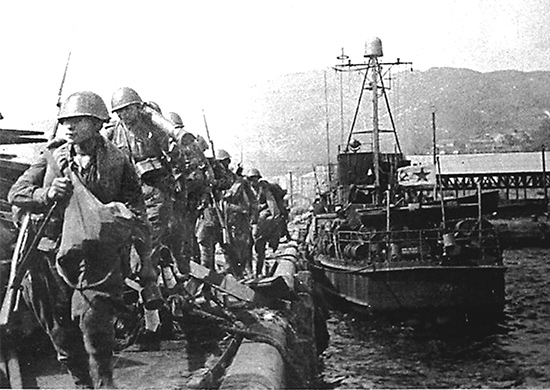
Soviet Amphibious Operations in Korea
North Korea
Political
5 min read
Updated By: History Editorial Network (HEN)
Published:
Updated:
As World War II neared its conclusion, Soviet forces launched amphibious operations along the northeastern coast of Korea. This movement came after the Soviet Union declared war on Japan, aligning with the Allied push to end the conflict in the Pacific. Soviet troops swiftly advanced from the north, encountering limited Japanese resistance primarily because Japanese forces were already stretched thin due to engagements in other theaters.
The landings marked a strategic push that contributed to the rapid occupation of the Korean Peninsula's northern region. The advancing Soviet forces coordinated movements with the United States and other Allied powers to dismantle the remaining Japanese control over the occupied territories. The Soviet invasion had significant implications for the future geopolitical landscape of Korea. As Soviet and American forces met along the 38th parallel, the groundwork was laid for the eventual division of Korea into two separate zones, leading to the establishment of North and South Korea.
The amphibious landings and the subsequent Soviet advancement facilitated the reorganizing of Korean administrative structures in the north. Soviet influence became a determining factor in the political alignment and governance of what would later become the Democratic People's Republic of Korea (North Korea). This set the stage for the Cold War power dynamics in the region, characterized by the ideological divide between the communist North and the capitalist South.
The Soviet's military operation contributed significantly to the liberation of Korea from Japanese rule but also triggered a series of events culminating in the Korean War a few years later and the long-lasting division of the peninsula. The amphibious assault by Soviet forces was a pivotal moment that not only concluded Japanese dominance in the region but also initiated a new chapter in Korean history, deeply influenced by global superpower interests and conflicts.
#WWII #KoreanPeninsula #SovietForces #AmphibiousLanding #Geopolitics #MilitaryHistory #ColdWar #MoofLife
Primary Reference
NORTH KOREA
Explore the Life Moments of
 AI Twin