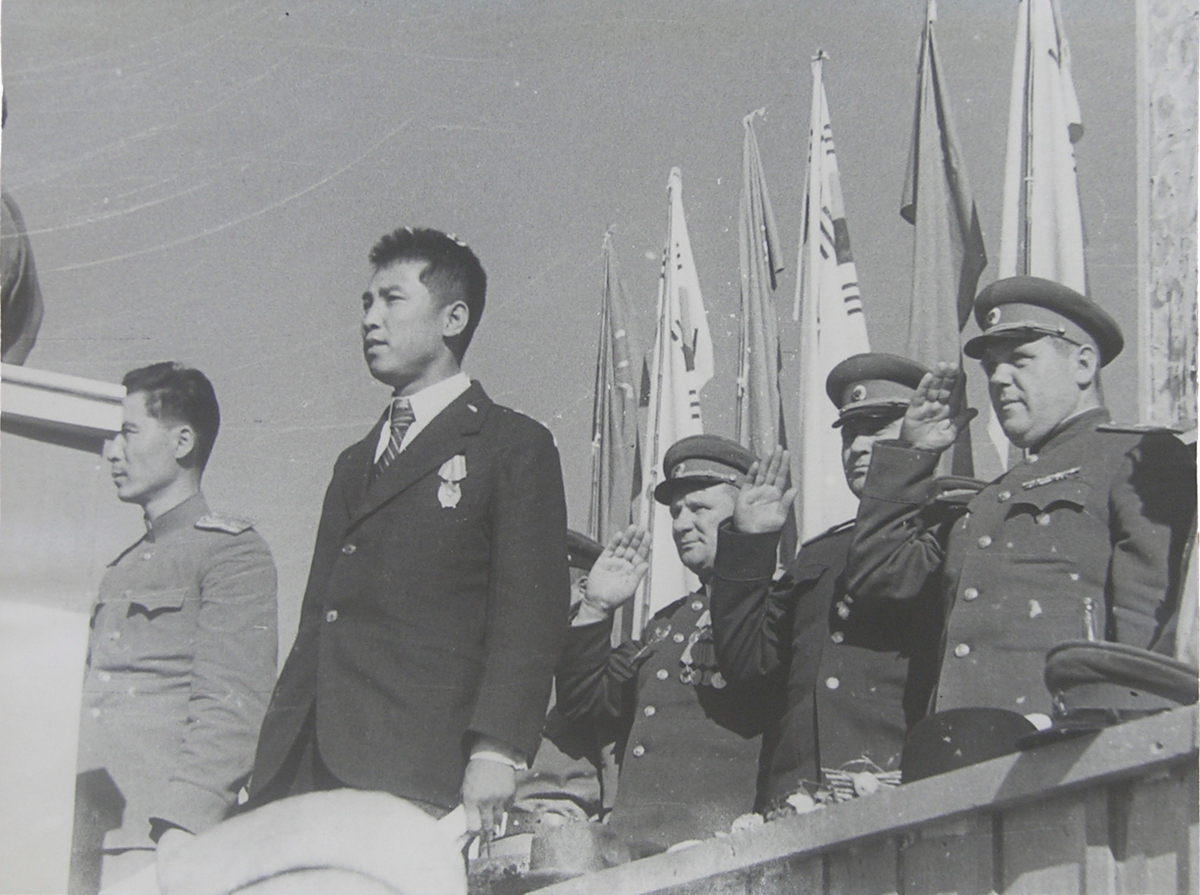
Formation of North Korean Communist Party under Kim Il Sung: A Critical Power Shift.
North Korea
Political
5 min read
Updated By: History Editorial Network (HEN)
Published:
In the midst of a turbulent political landscape following the end of Japanese occupation, various local communist committees in Korea united to establish the North Korean Communist Party, led by Kim Il Sung. Kim Il Sung, who emerged as a prominent figure among communist circles, took the helm of this newly formed entity. This unification marked a critical consolidation of power within Korea, ultimately focused in the northern region.
The unification of these committees under Kim Il Sung's leadership came during a period of significant geopolitical realignment, with Korea's liberation from Japanese rule and subsequent division into North and South by international powers. The consolidation reflected the recognition of Kim Il Sung's leadership abilities and ideological alignment with the broader goals of the communist movement. This movement was supported by the Soviet Union, which had taken a keen interest in influencing the northern part of Korea.
The creation of the North Korean Communist Party laid the groundwork for the establishment of a socialist state, driven by the principles of Marxist-Leninist doctrine adapted to the Korean context. It signaled a shift in power dynamics, intensifying the ideological divide that would eventually lead to the formation of two distinct Korean states, each aligned with different superpowers in the emerging Cold War era.
The new party apparatus adopted policies aimed at land reforms, labor organization, and the nationalization of key industries, which drew substantial support from the working and peasant classes. The strategic decisions and political maneuvering by Kim Il Sung and his allies entrenched the communist ideology in the northern part of Korea, setting the stage for future governance structures.
In the broader context, this moment had profound implications for the Korean peninsula. It not only represented a pivotal point in the struggle for political supremacy but also laid the foundations for the ideological, political, and military tensions that would later manifest in the Korean War. This transformation would indelibly shape the trajectory of North Korea's socio-political landscape for decades to come.
The unification under Kim Il Sung's leadership is thus a well-documented development that marks the crystallization of communist power in the north, contributing to the shaping of modern Korean history.
#CommunistParty #KimIlSung #NorthKorea #ColdWar #PoliticalHistory #MoofLife
Primary Reference
Categorizing People in the New States: A Comparative Study of ...
Explore the Life Moments of
 AI Twin