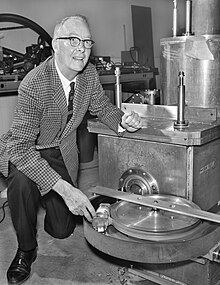
Luis Alvarez: Nobel Prize for Experimental Physics and Discovery of Resonance States
Sweden
Science
4 min read
Updated By: History Editorial Network (HEN)
Published:
Luis Walter Alvarez, an American experimental physicist, was awarded the Nobel Prize in Physics for his contributions to particle physics, specifically his discovery of resonance states through the hydrogen bubble chamber technique. Alvarez's work played a crucial role in advancing the understanding of subatomic particles and the fundamental forces governing their interactions.
The hydrogen bubble chamber, developed by Donald Glaser, is a device that allows scientists to visually track the movement of charged particles within a superheated liquid hydrogen environment. Alvarez refined this technique, making it a powerful tool for detecting and analyzing short-lived resonance states in particle physics experiments. His innovative use of the bubble chamber enabled the discovery of numerous resonance states and detailed studies of particle interactions that were previously impossible to observe.
Alvarez's research significantly impacted the field of high-energy physics, contributing to the development of the quark model and the understanding of strong and weak nuclear forces. His work laid the foundation for future experimental techniques and discoveries, influencing generations of physicists.
Luis Alvarez's achievements underscore the importance of experimental ingenuity in advancing scientific knowledge. The hydrogen bubble chamber technique not only facilitated groundbreaking discoveries in particle physics but also demonstrated the value of precise experimental methods in uncovering the mysteries of subatomic particles.
#ParticlePhysics #NobelPrize #LuisAlvarez #HydrogenBubbleChamber #ScientificDiscovery #MoofLife
Primary Reference
Luis Walter Alvarez - Wikipedia
Explore the Life Moments of
 AI Twin