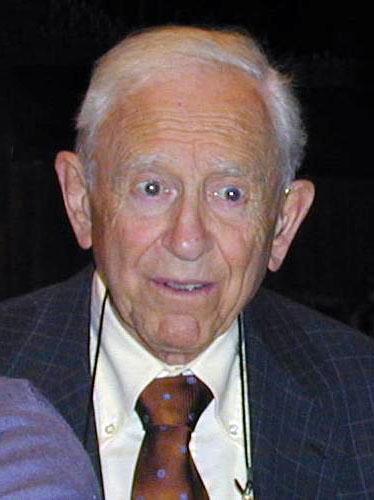
Legacy of Nobel Laureate Franco Modigliani: Shaping Economic Thought and Financial Markets
Sweden
Economic
Academic Research
4 min read
Updated By: History Editorial Network (HEN)
Published:
Franco Modigliani was honored with the Nobel Prize in Economic Sciences for his groundbreaking work on the behavior of savings and the functioning of financial markets. His contributions have had a profound impact on modern economic thought and policy. Modigliani's life-cycle hypothesis of savings posits that individuals plan their consumption and savings behavior over their lifetime with the aim of smoothing consumption, which has led to a better understanding of savings patterns.
Additionally, his pioneering work alongside Merton Miller on the Modigliani-Miller theorem revolutionized the way economists and financial analysts view corporate finance. This theorem demonstrated that, under certain conditions, the value of a firm is unaffected by how it is financed, whether through debt or equity. This insight has far-reaching implications for corporate financial strategy and market analysis.
Modigliani's research provided empirical support for many economic policies and helped in the development of theoretical models that economists use to predict consumer behavior and financial market operations. His work laid the groundwork for subsequent studies in these fields, influencing both academic research and practical applications in policy-making and financial management.
Overall, Franco Modigliani's contributions have significantly shaped contemporary economic and financial theories, leaving a lasting legacy that continues to influence the field.
#MoofLife #NobelPrize #EconomicSciences #FinancialMarkets #SavingsBehavior #ModiglianiMillerTheorem
Primary Reference
The Prize in Economics 1990 - Press release - NobelPrize.org

Explore the Life Moments of
 AI Twin