The Role of Tesla and Westinghouse Electric at the 1893 World's Columbian Exposition
Croatia
Technology
Innovation
5 min read
Updated By: History Editorial Network (HEN)
Published:
Updated:
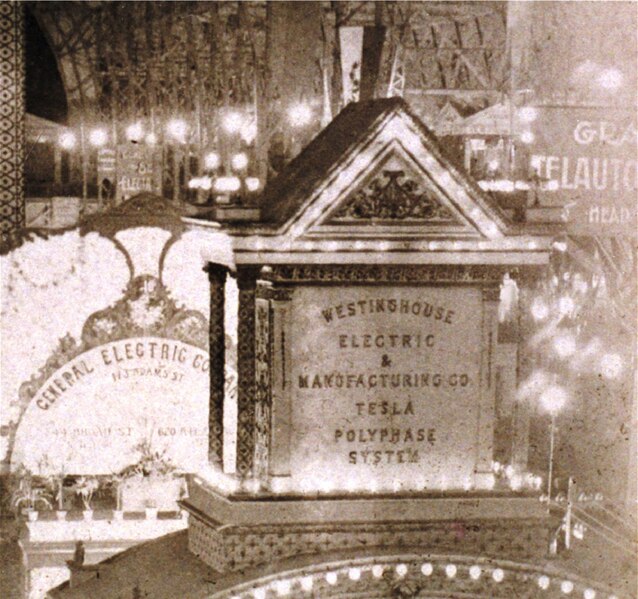
By the beginning of 1893, Westinghouse engineer Charles F. Scott and then Benjamin G. Lamme had made progress on an efficient version of Tesla's induction motor. Lamme found a way to make the polyphase system it would need compatible with older single-phase AC and DC systems by developing a rotary converter. Westinghouse Electric now had a way to provide electricity to all potential customers and started branding their polyphase AC system as the 'Tesla Polyphase System'. They believed that Tesla's patents gave them patent priority over other polyphase AC systems. Westinghouse Electric asked Tesla to participate in the 1893 World's Columbian Exposition in Chicago where the company had a large space in the 'Electricity Building' devoted to electrical exhibits. Westinghouse Electric won the bid to light the Exposition with alternating current and it was a key event to demonstrate to the American public the safety, reliability, and efficiency of an alternating current system that was polyphase and could also supply the other AC and DC exhibits at the fair. A special exhibit space was set up to display various forms and models of Tesla's induction motor. The rotating magnetic field that drove them was explained through a series of demonstrations including an Egg of Columbus that used the two-phase coil found in an induction motor to spin a copper egg making it stand on end. Tesla visited the fair for a week during its six-month run to attend the International Electrical Congress and put on a series of demonstrations at the Westinghouse exhibit. A specially darkened room had been set up where Tesla showed his wireless lighting system, using a demonstration he had previously performed throughout America and Europe; these included using high-voltage, high-frequency alternating current to light wireless gas-discharge lamps. An observer noted: Within the room were suspended two hard-rubber plates covered with tin foil. These were about fifteen feet apart and served as terminals of the wires leading from the transformers. When the current was turned on, the lamps or tubes, which had no wires connected to them, but lay on a table between the suspended plates, or which might be held in the hand in almost any part of the room, were made luminous. These were the same experiments and the same apparatus shown by Tesla in London about two years previous, 'where they produced so much wonder and astonishment'.

Explore the Life Moments of
 AI Twin