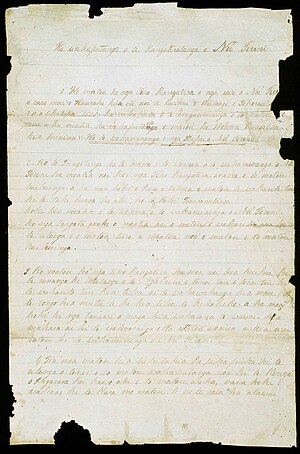
Declaration of Independence of New Zealand by the "Confederation of United Tribes" signed by 34 northern chiefs (and later by another 18).
New Zealand
10 min read
Updated By: History Editorial Network (HEN)
Published:
Updated:
In October 1835, a significant event in New Zealand's history occurred when the Declaration of Independence was signed by 34 northern Māori chiefs, forming the "Confederation of United Tribes." This declaration was later signed by an additional 18 chiefs, solidifying the move toward asserting Māori sovereignty and unity in the face of increasing European influence and settlement.
Background: The Context Leading to the Declaration
By the early 19th century, European contact with New Zealand had increased significantly. Whalers, traders, and missionaries began to establish a presence, leading to profound changes in Māori society and increasing tensions over land and resources. The British government and other European powers recognized the strategic importance of New Zealand and the need to establish a formal relationship with its indigenous people to protect their interests.
James Busby’s Role
James Busby, appointed as the British Resident in New Zealand in 1833, played a crucial role in facilitating the Declaration. His mission was to mediate between the Māori and European settlers and to establish some form of governance to prevent lawlessness and protect British subjects. Busby saw the creation of a confederation of Māori tribes and a declaration of independence as a way to unify the Māori chiefs and create a stable political entity that could engage with the British government on more equal terms.
The Declaration of Independence
The Declaration of Independence of New Zealand, known in Māori as He Whakaputanga o te Rangatiratanga o Nu Tireni, was signed on October 28, 1835, at Waitangi. The initial 34 chiefs, primarily from the northern regions, declared their sovereignty and established the "Confederation of United Tribes." The document proclaimed the independence of New Zealand under the united authority of the chiefs and sought recognition and protection from the British Crown.
Key Provisions of the Declaration
Sovereignty: The chiefs declared the sovereign independence of New Zealand and asserted that all sovereign power and authority resided with them collectively in their confederation.
Governance: They agreed to meet annually to frame laws for the management of their territories and to establish a national assembly.
Protection: The chiefs requested the protection and recognition of their independence by the British Crown, asking King William IV to become the guardian of their infant state.
Trade and Justice: They sought to regulate trade and relationships with foreigners, emphasizing the need for order and justice in interactions with Europeans.
Significance and Impact
The Declaration of Independence was a critical assertion of Māori authority and an early step towards establishing a formal relationship with the British Crown. It was intended to protect Māori interests and land from potential colonization pressures and to create a unified front in dealings with foreign powers.
The British government recognized the declaration in 1836, acknowledging New Zealand's independence and the confederation's authority. However, the declaration did not result in immediate changes in governance, as the Māori chiefs continued to govern their territories independently without a central authority.
Path to the Treaty of Waitangi
While the Declaration of Independence was a significant assertion of Māori sovereignty, it did not fully address the complexities and challenges of increasing European settlement. By the late 1830s, the need for a more comprehensive agreement became evident, leading to the Treaty of Waitangi in 1840.
The Treaty of Waitangi, signed by many Māori chiefs and representatives of the British Crown, sought to establish a framework for governance, land ownership, and the protection of Māori rights under British law. The treaty is often considered the founding document of modern New Zealand, although its interpretation and implementation have been sources of controversy and debate.
Legacy of the Declaration
The Declaration of Independence remains a vital part of New Zealand's history and a symbol of Māori sovereignty and unity. It is celebrated annually on October 28 as a day of national significance, particularly among Māori communities. The declaration's principles continue to influence contemporary discussions about Māori rights, governance, and the relationship between the Crown and Māori.
#MomentsOfLife #MoofLife_Moment #MoofLife #NewZealandHistory #DeclarationOfIndependence #MāoriSovereignty #HeWhakaputanga #UnitedTribes #TreatyOfWaitangi
Primary Reference
Declaration of Independence | NZ History
Explore the Life Moments of
 AI Twin