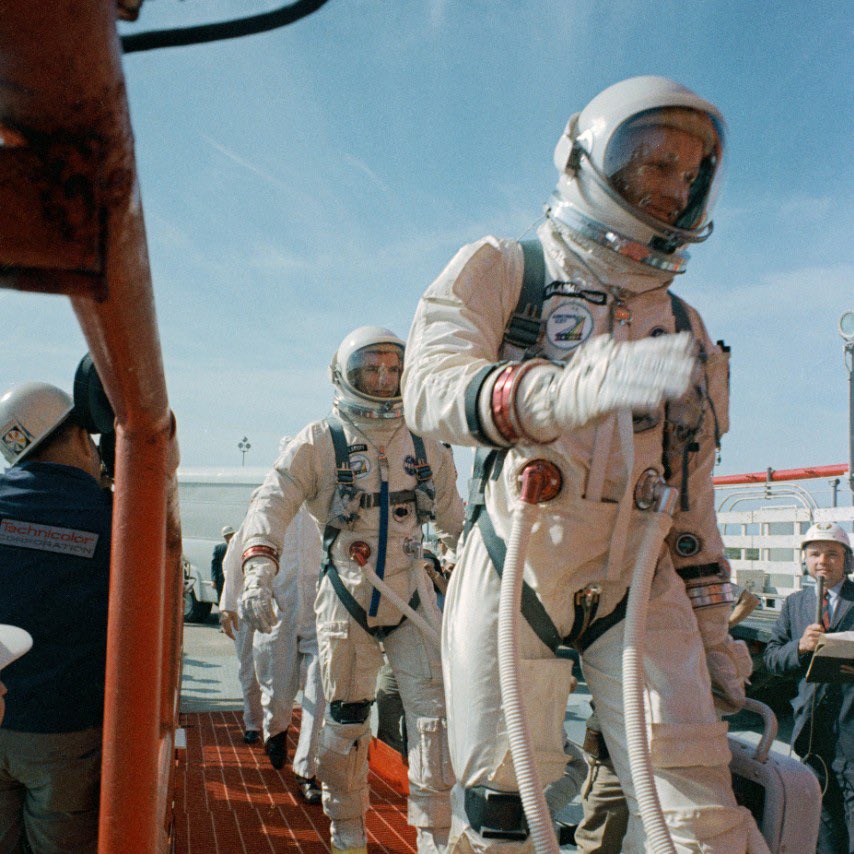
Neil Armstrong Commanded Gemini 8 And Achieved First Spacecraft Docking In 1966
United States of America

Space Exploration
Aerospace History
NASA Missions
5 min read
Updated By: History Editorial Network (HEN)
Published:
Updated:
Gemini 8 launched on March 16, 1966. It was the most complex mission yet, with a rendezvous and docking with an uncrewed Agena target vehicle, and the planned second American spacewalk (EVA) by Scott. The mission was planned to last 75 hours and 55 orbits. After the Agena lifted off at 10:00:00 EST, the Titan II rocket carrying Armstrong and Scott ignited at 11:41:02 EST, putting them into an orbit from which they chased the Agena. They achieved the first-ever docking between two spacecraft. Contact with the crew was intermittent due to the lack of tracking stations covering their entire orbits. While out of contact with the ground, the docked spacecraft began to roll, and Armstrong attempted to correct this with the Gemini's Orbit Attitude and Maneuvering System (OAMS). Following the earlier advice of Mission Control, they undocked, but the roll increased dramatically until they were forced to use the Reentry Control System (RCS) and turned off the OAMS. Mission rules dictated that once this system was turned on, the spacecraft had to reenter at the next possible opportunity. It was later thought that damaged wiring caused one of the thrusters to stick in the on position. A few people in the Astronaut Office, including Walter Cunningham, felt that Armstrong and Scott 'had botched their first mission'. There was speculation that Armstrong could have salvaged the mission if he had turned on only one of the two RCS rings, saving the other for mission objectives. These criticisms were unfounded; no malfunction procedures had been written, and it was possible to turn on only both RCS rings, not one or the other. Gene Kranz wrote, 'The crew reacted as they were trained, and they reacted wrong because we trained them wrong.' The mission planners and controllers had failed to realize that when two spacecraft were docked, they must be considered one spacecraft. Kranz considered this the mission's most important lesson. Armstrong was depressed that the mission was cut short, canceling most mission objectives and robbing Scott of his EVA. The Agena was later reused as a docking target by Gemini 10. Armstrong and Scott received the NASA Exceptional Service Medal, and the Air Force awarded Scott the Distinguished Flying Cross as well. Scott was promoted to lieutenant colonel, and Armstrong received a $678 raise in pay to $21,653 a year (equivalent to $203,338 in 2023), making him NASA's highest-paid astronaut.

Explore the Life Moments of
 AI Twin