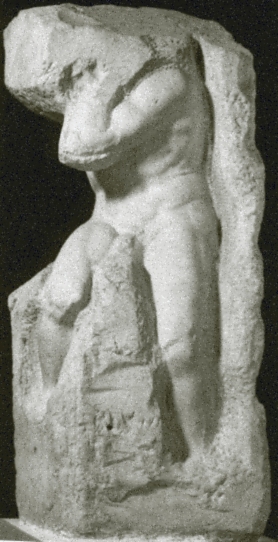
Michelangelo's 'Atlas Slave': Unfinished masterpiece symbolizes human struggle and artistic liberation.
Italy
Art
4 min read
Updated By: History Editorial Network (HEN)
Published:
Updated:
Michelangelo, one of the Renaissance's preeminent artists, was commissioned to create sculptures for Pope Julius II's tomb. Among the series of statues known as the 'Prisoners' or 'Slaves,' the 'Atlas Slave' stands out. This artwork features a figure struggling to emerge from the marble block, symbolizing a human form wrestling against the stony bondage of its existence. Crafted between two significant projects, the tomb of Pope Julius II and the Medici Chapel in Florence, the 'Atlas Slave' reflects Michelangelo’s belief in the artist's hand unleashing the form trapped within the stone.
This period in Michelangelo’s life was marked by immense pressure and creative complexity. The original plan for the tomb, commissioned decades earlier, had undergone numerous revisions due to financial constraints, political changes, and disagreements between Michelangelo and the Pope’s heirs. These factors resulted in several partially-completed statues. Michelangelo’s dedication to anatomical precision and emotional expression is evident in the unfinished 'Atlas Slave,' revealing the artist’s process and intention.
The 'Atlas Slave' captures not only Michelangelo's mastery but his philosophical approach to art. It exemplifies the Renaissance perspective on human struggle, encapsulating themes of liberation and the constant struggle towards enlightenment and perfection. Though it remains unfinished, it has significantly impacted both contemporaneous art circles and future generations, influencing the Mannerist movement and other artists who viewed incompletion as a legitimate and powerful artistic statement.
#Michelangelo #RenaissanceArt #UnfinishedSculptures #PopeJuliusIITomb #AtlasSlave #MoofLife
Explore the Life Moments of
 AI Twin